By Tom Adkinson
October 23, 2026
 |
|---|
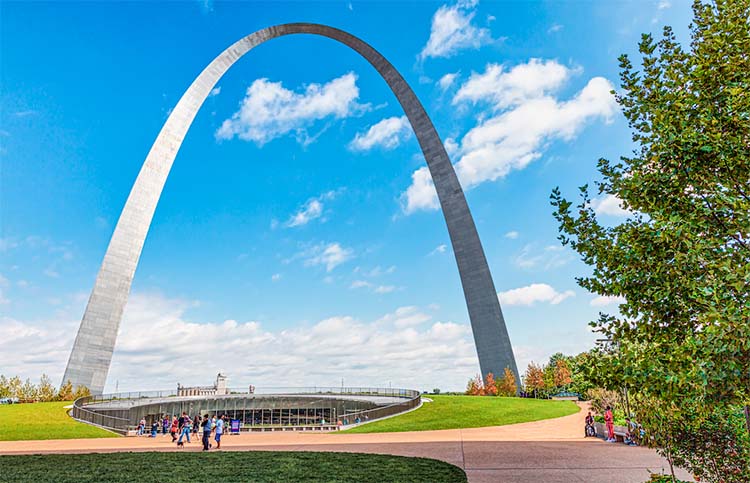
The Gateway Arch instantly became the internationally recognized landmark of St. Louis when it was completed in 1965. Image by Burt Remis/Explore St. Louis |
ST. LOUIS – You could go to Manhattan and not see the Statue of Liberty, but it is impossible to visit downtown St. Louis and not see the Gateway Arch. It’s that big.
The massive piece of public art reaches 630 feet into the Missouri sky; it also measures 630 feet wide at its base. It is the focal point of Gateway Arch National Park, and it packs a variety of stories from American history into a small space at the heart of a bustling city.
It makes high school history classes about European settlement in the middle of North America, the Louisiana Purchase, the Lewis and Clark expedition, and even the Supreme Court’s maligned Dred Scott decision come to life.
 |
|---|
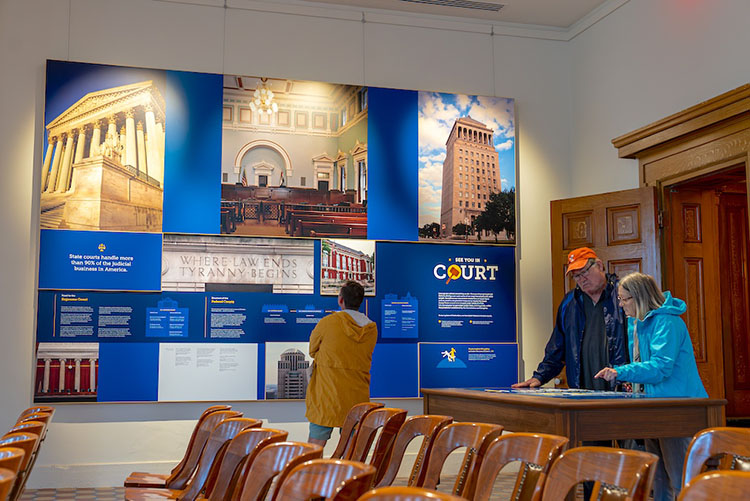
| Courtrooms in the Old Courthouse, one of the oldest buildings in St. Louis, saw momentous trials, including two involving Dred Scott. It is part of Gateway Arch National Park. Image by Explore St. Louis |
“Start your visit to St. Louis at the Gateway Arch. It delivers an unforgettable beginning to any visit here,” said Brad Dean, CEO of Explore St. Louis, the city’s convention and visitors bureau.
It was in the 1930s when civic leaders envisioned a commemorative site to interpret President Thomas Jefferson’s vision of a nation that spanned the continent and St. Louis’s role in the nation’s westward movement. However, their ideas stretched farther back into history – two centuries earlier – when French explorers and settlers were poking around the region.
 |
|---|
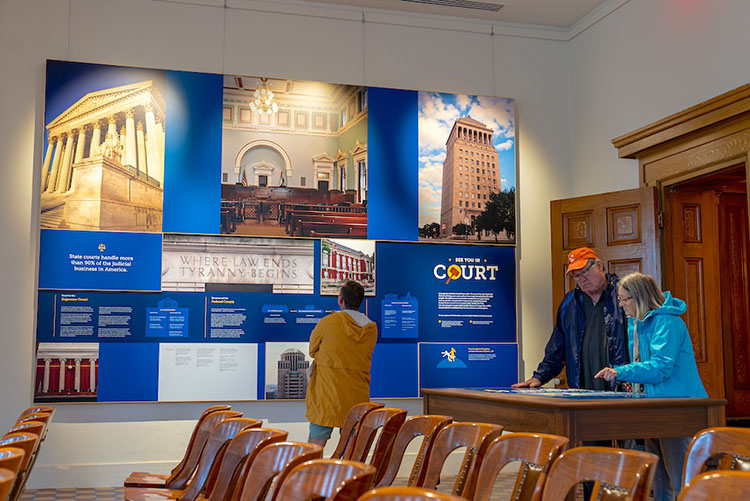
| The message of “Where Law Ends, Tyranny Begins” is prominent in “See You in Court,” a new gallery in the Old Courthouse. A building renovation was completed in 2025. Image by Explore St. Louis |
Today’s national park covers only 91 acres (it is the smallest national park), and its boundaries encompass the 62-acre site of the colonial French town of St. Louis. French settlers were in the region in the early 1700s, and Pierre Laclede came up the Mississippi River from New Orleans (then a French settlement) to establish the trading post that became St. Louis in 1764. The fledgling outpost changed hands – France to Spain and again back to France – before Jefferson’s Louisiana Purchase put it under the American flag in 1803.
The very next year was when the Lewis and Clark Expedition set out from St. Louis up the Mississippi and Missouri rivers to explore the vast expanse of the Louisiana Purchase. That real estate deal had overnight doubled the size of the United States. A museum at the arch’s ground level details Lewis and Clark’s extraordinary journey that went all the way to the Pacific Ocean at the mouth of another great river, the Columbia.
 |
|---|
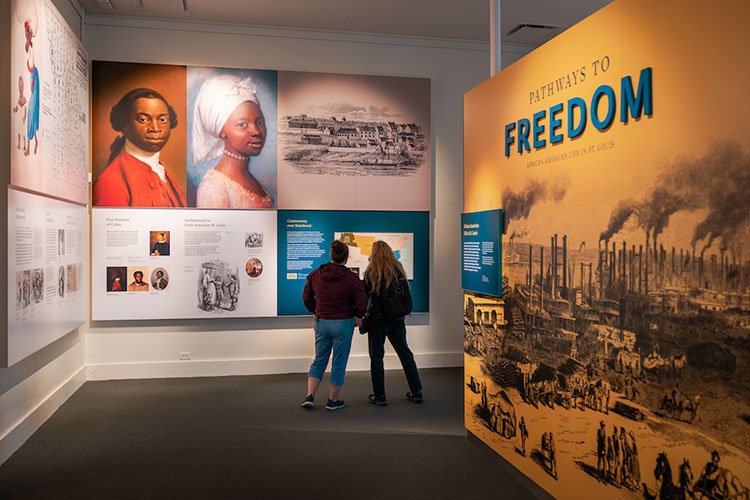
| “Pathways to Freedom,” an exhibit in the newly renovated Old Courthouse, illuminates Missourians’ struggles with slavery, citizenship and freedom. Image by Explore St. Louis |
The St. Louis civic leaders who dreamed of a commemorative park mulled over ideas for years before a 1947-1948 architectural competition that drew 172 entries and called for “a large, central feature” settled on the now-famous arch concept. The designer was a Finnish-American architect, Eero Saarinen.
Cramped, claustrophobic to some, trams glide inside the arch’s stainless steel legs to an observation area at the top. The view to the east is across the Mississippi River into Illinois, and the view west is into Missouri. Use your imagination to look beyond the expanse of modern St. Louis to see where Lewis and Clark traveled.
 |
|---|
| The Gateway Arch rises to the sky near a St. Louis public art installation called the Mural Mile. “Canvases” for the Mural Mile are floodwall panels that are repainted annually. Image by Explore St. Louis |
The downward view from the arch’s narrow windows is to another St. Louis landmark that also is part of the national park. That historic structure, built between 1839 and 1862 and renovated in 2025, was where Dred and Harriet Scott sued for their freedom (1847 and 1850) and where pioneer Missouri suffragette Virginia Minor sought, but failed to obtain, the right to vote (1872).
 |
|---|
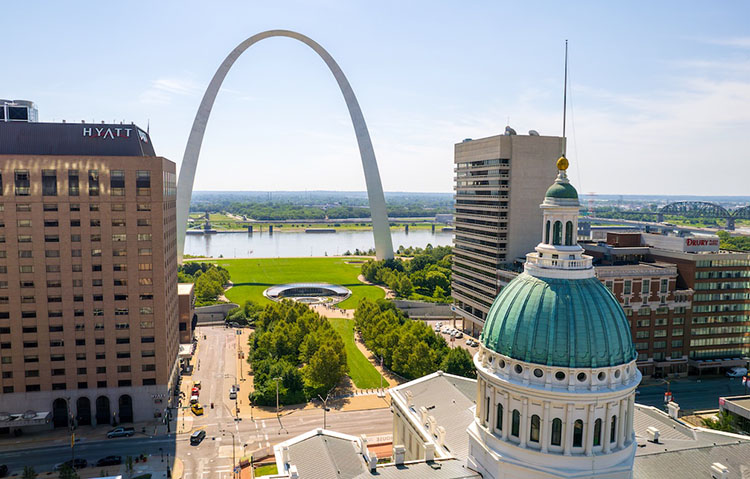
| Gateway Arch National Park is in the heart of downtown St. Louis on the banks of the Mississippi River and with hotels nearby. Image by Explore St. Louis |
Trip-planning resources: NPS.gov/jeff and ExploreStLouis.com
(Travel writer Tom Adkinson’s book, 100 Things To Do in Nashville Before You Die, is available at Amazon.com.