By Tom Adkinson
May 8, 2026
 |
|---|
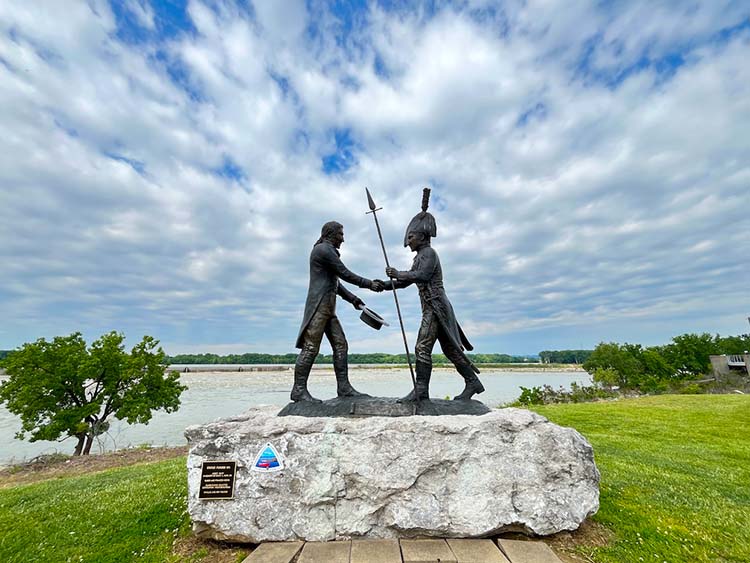
| A reminder of the Falls of the Ohio cascades behind a statue of explorers Meriwether Lewis and William Clark. Image by Tom Adkinson |
CLARKSVILLE, Ind. – The route to Indiana’s Falls of the Ohio State Park takes you through neighborhoods of modest homes. to a spot notable in American history, and finally to a destination to see evidence of life 390 million years ago. Toss in opportunities for a woodland walk, birding, and picnicking, and this is a park with an abundance of selling points.
 |
|---|
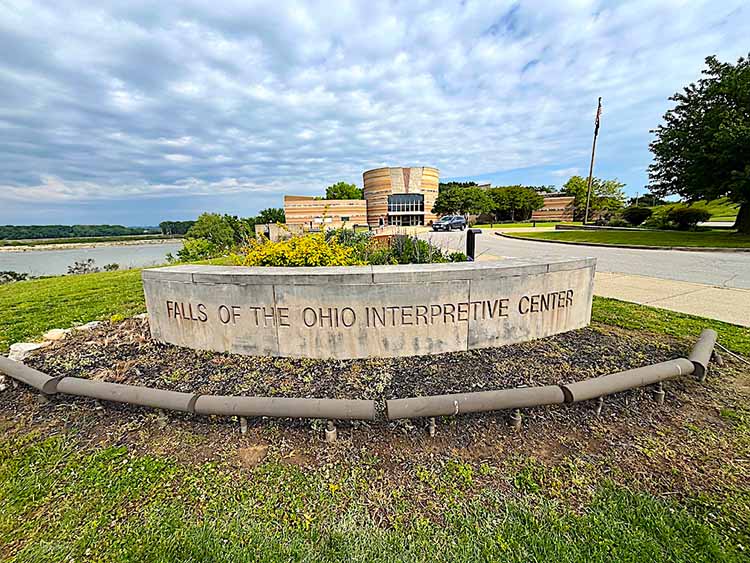
| The interpretive center at Falls of the Ohio State Park tells stories from millions of years ago – and from today. Image by Tom Adkinson |
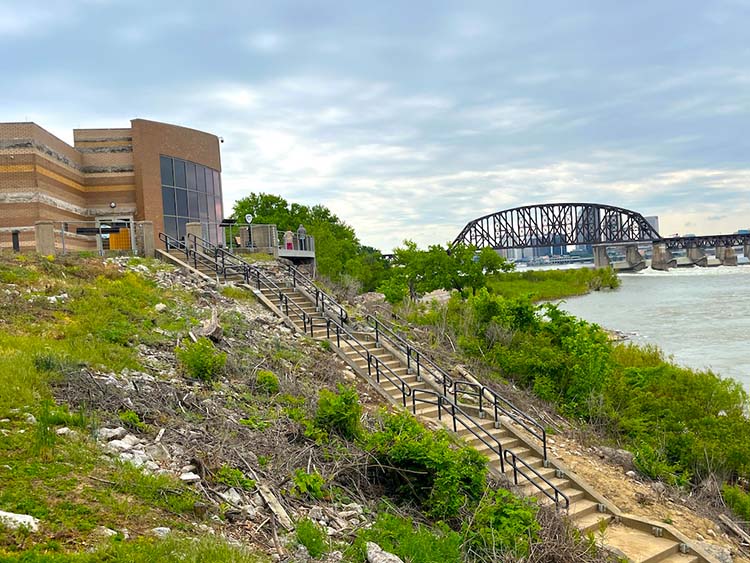
The park is across the Ohio River from downtown Louisville, Ky., and the city skyline is prominent from the park’s interpretive center. In fact, the park and downtown are linked by an easy 2.4-mile walk along the Ohio River Greenway and the Big Four Bridge, a one-time railroad bridge now reserved for pedestrians and cyclists.
 |
|---|
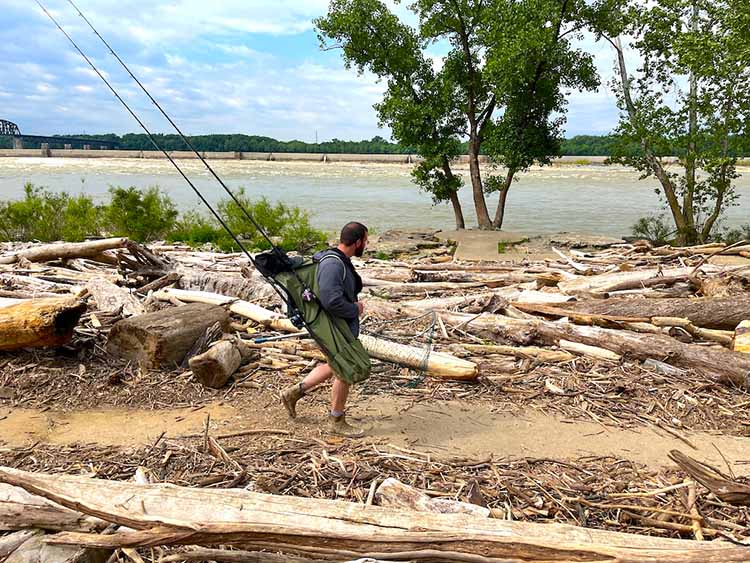
| An angler ambles down a path through reminders of the Ohio River’s last high-water mark on the way to a fishing spot. Image by Tom Adkinson |
First-time visitors to the interpretive center, the greenway, or the bridge might easily wonder where the waterfall is. The Falls of the Ohio were a notable obstruction on the river, but no one ever would have compared them to Niagara Falls. Instead, the Falls of the Ohio were a series of rapids flowing over limestone ledges that made early river traffic here a dangerous proposition.
The rugged section began at what is now downtown Louisville and dropped 26 feet over the next 2.5 miles. This was the only fall on the 981-mile length of the Ohio River. A canal and then other projects strived to permit navigation, and water behind a 1920s-era dam finally inundated most of the falls. The modern McAlpine Dam has locks to facilitate barges and recreational boats.
 |
|---|
| The skyline of Louisville, Ky., is just upriver from Falls of the Ohio State Park in Clarksville, Ind. Image by Tom Adkinson |
Some of those rocky ledges are accessible during low water, and what scientists have found makes the park especially interesting. Their discoveries reach back 390 million years and include 600 types of Devonian Period fossils, some the size of a pencil tip and others the size of a school bus.
When the animals that became those fossils lived, this region was at the bottom of a tropical sea south of the equator. None of the plants and animals alive on Earth today existed then. Dr. William Andrews, a geologist with the Kentucky Geological Survey, explains in layman’s terms Earth’s geologic development, the ultimate creation of the Ohio River, and the significance of the fossil records in a set of videos in the interpretive center.
 |
|---|
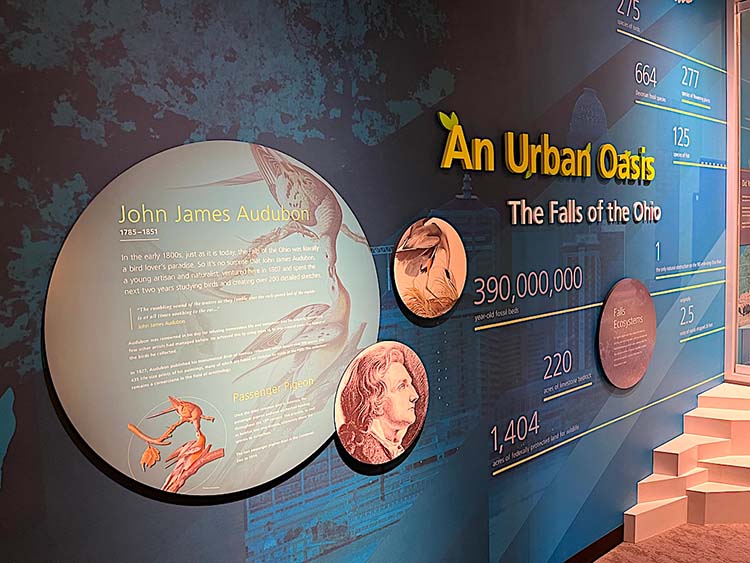
| A display in the state park’s interpretive center tells how artist/naturalist John James Audubon spent time sketching at the Falls of the Ohio. Image by Tom Adkinson |
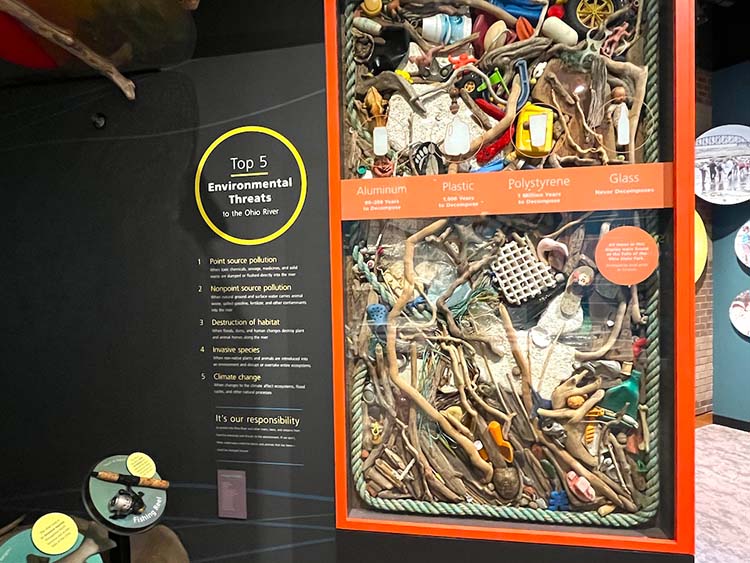
Another portion of the center examines the Ohio River today, with a focus on wildlife and a display about contemporary environmental threats. One compelling display is a collection of trash pulled from the river – aluminum that will take up to 200 years to decompose, plastic that will last 1,000 years, polystyrene with a million-year lifespan and glass that never decomposes.
 |
|---|
A display in the park’s interpretive center explains that human-made items cast into the Ohio River will last for millennia. Image by Tom Adkinson |
Humans have always enjoyed the region’s wildlife and natural setting. Indigenous societies fished in the river, naturalist John James Audubon made more than 200 sketches of 14 bird species while he lived in the falls area, and both Mark Twain and Walt Whitman wrote about the falls.
Beyond Audubon, Twain, and Whitman, other figures in American history figure into the Falls of the Ohio story. You will recognize two of them: Meriwether Lewis and William Clark. Lewis rode a custom-made keelboat down the Ohio in 1803 until he reached the treacherous Falls of the Ohio to link up with Clark. That was a prelude to their expedition to explore the Louisiana Purchase and find a way to the Pacific Ocean. Along the way, they encountered waterfalls bigger, but perhaps not more significant, than the Falls of the Ohio.
Trip-planning resources: In.gov, FallsOfTheOhio.org and GoSoIN.com
(Travel writer Tom Adkinson’s book, 100 Things To Do in Nashville Before You Die, is available at Amazon.com.