By Tom Adkinson
November 6, 2026

Amazon Best Sellers
#Commissions earned
 |
|---|
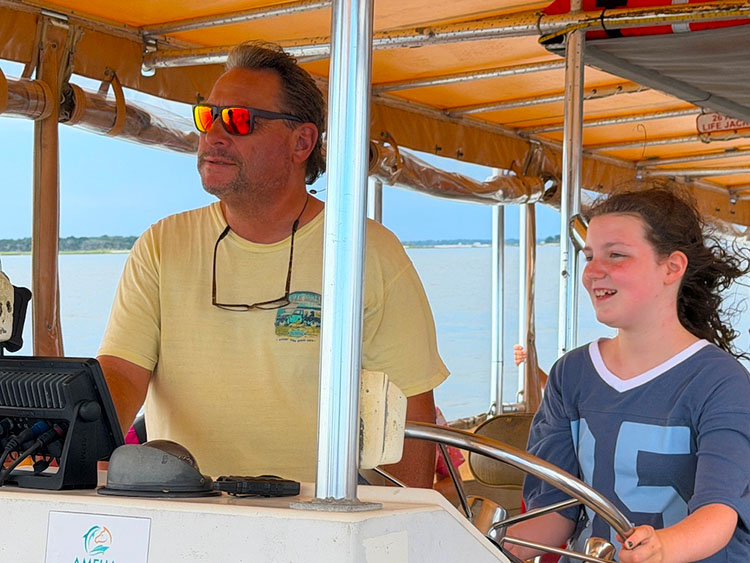
| Hazel Tatum is all smiles as she handles the Miss Kaylynn through the Cumberland Sound under the watchful eye of Nate Parsons. Image by Tom Adkinson |
FERNANDINA BEACH, Fla. – The youngster sitting next to excursion boat captain Nate Parsons didn’t care that her afternoon cruise had already encountered playful dolphins, sinister-looking alligators and an osprey winging its way home with a fish in its talons.
No, the youngster didn’t care about all of the wonders of nature she had seen because for a few minutes SHE WAS DRIVING THE BOAT!
 |
|---|
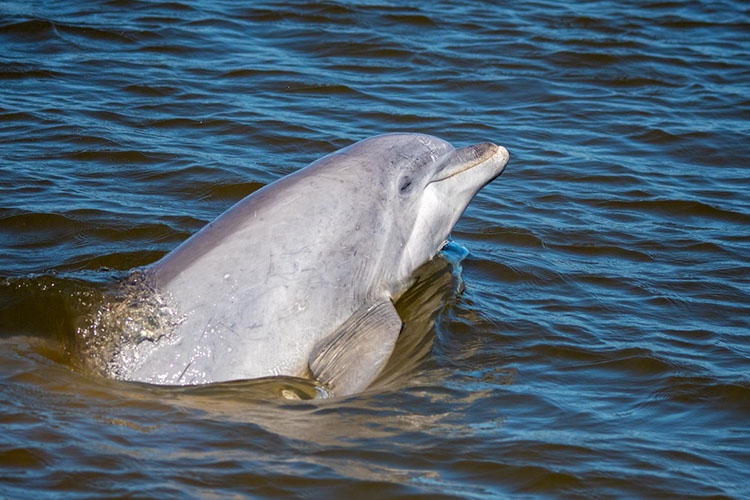
| A bottlenose dolphin arcs out of the water next to one of the excursion boats of Amelia River Cruises. Dolphins, manatees, and submarines are the biggest objects to spot. Image from Amelia River Cruises |
That’s the kind of memories Kevin McCarthy, owner of Amelia River Cruises, wants to create during trips on the 45-passenger Miss Kaylynn and three other boats he operates from Fernandina Beach in the far northeast corner of Florida. The town is on Amelia Island, and the town name and the island name are sometimes used interchangeably.
McCarthy and his family have been showing off their watery neighborhood since 2000. The cruises don’t have to travel very far for passengers to find nature, explore history, admire beautiful scenery, and occasionally see nuclear submarines (more about the subs later).
|
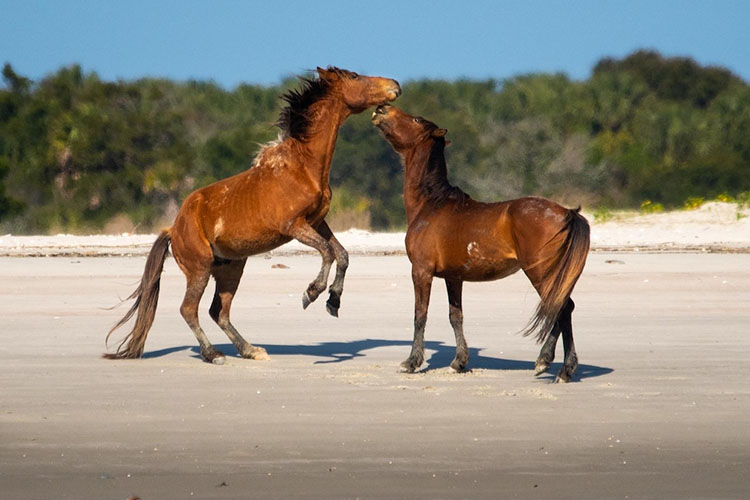
In fact, not too long after leaving the dock in Florida, McCarthy’s excursion boats cross an imaginary line in the water and enter Georgia on their way to Cumberland Island.
Like Amelia Island, Cumberland Island is an Atlantic barrier island. Unlike Amelia, however, Cumberland is mostly National Park Service land and therefore largely undeveloped.
That’s one reason Cumberland Island is rich in animal life, including feral horses that are often visible on the beach. Although horses have been on Cumberland Island since Spanish colonists arrived in the 1700s, the current wild horses didn’t descend from them. The park service traces today’s horses to human residents well into the 1900s.
 |
|---|
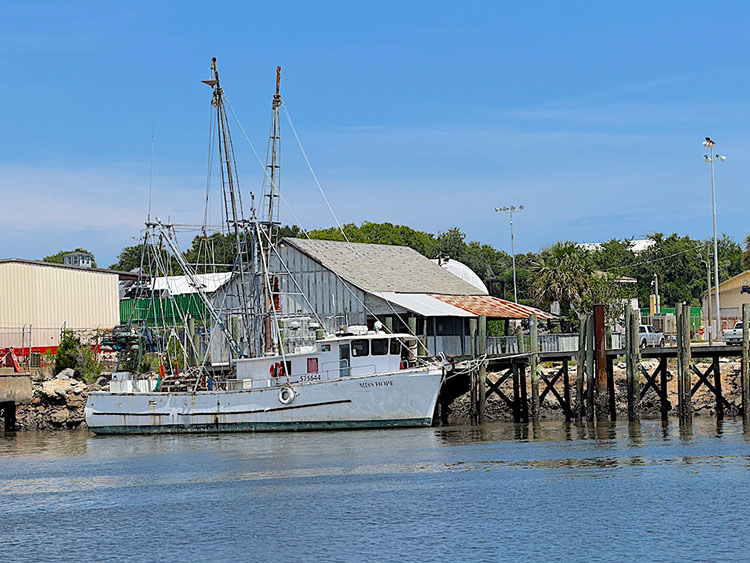
| The Miss Hope is one of only a handful of shrimp boats working out of Fernandina Beach, the community whose innovations help spawn modern shrimping techniques. Image by Tom Adkinson |
A trip with Amelia River Cruises is an engaging mix of history and nature.
For instance, seeing a shrimp boat such as the Miss Hope at dock is a springboard for cruise captain Parsons to explain that Fernandina Beach was the birthplace of the modern shrimping industry that once flourished here. However, foreign competition and other economic stresses have diminished the shrimp boat fleet here from more than 100 to less than a half-dozen today.
Parsons says the public boat ramp just past the Miss Hope is one of his favorite spots on the cruise.
“Post up here for a while, and you can see trucks go (down the ramp) into the water, boats sink, and jet skis go skimming across the parking lot. It’s the best free entertainment in town,” he said before turning his attention to the area’s more serious sites.
 |
|---|
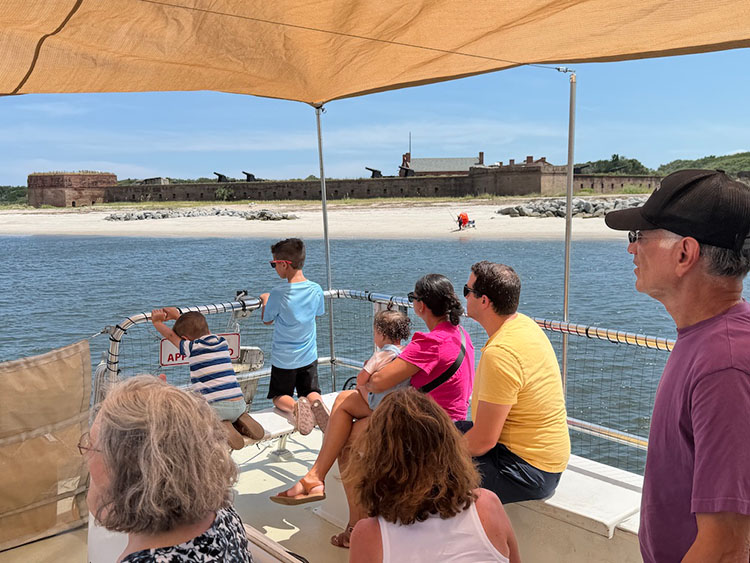
| Cannons never fired in anger line the parapets of Fort Clinch. Construction began in 1847, but the fort never saw real action in the Civil War or the Spanish-American War. It became a Florida state park in 1935. Image by Tom Adkinson |
The biggest of those is Fort Clinch, the namesake of Fort Clinch State Park. The masonry fort guards the entrance to the Cumberland Sound and the St. Mary’s River. Construction began in 1847, but even by the start of the Civil War, it was incomplete and had no cannons. The Army made it a barracks and ammunition depot in the short-lived Spanish-American War, and it eventually became one of Florida’s first state parks in 1935.
Beyond its on-again, off-again military use, many visitors today come to fish from its beach and hunt for fossilized shark teeth. The churn of the water at the point of land where the fort sits is known widely for delivering teeth to observant beachcombers.
 |
|---|
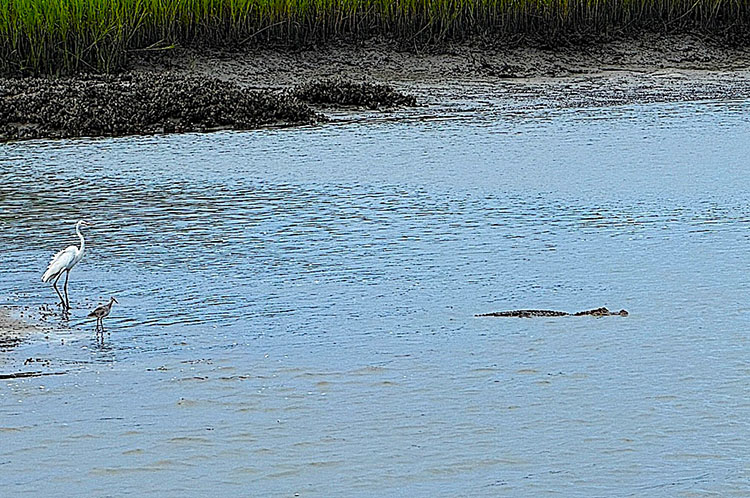
| An alligator swims into open water while two shore birds make sure it continues to move away from them. Image by Tom Adkinson |
Teeth of another kind command attention when the Miss Kaylynn glides up Beach Creek on Cumberland Island. This time, the teeth are attached to alligators that seem oblivious to the sightseers passing by.
Animal sightings can accumulate quickly in the creek and on open water: estuary dolphins, bottlenose dolphins, bald eagles, roseate spoonbills, belted kingfishers, ospreys, and even bulbous, slow-moving manatees in warm months.
As thrilling as it is to see some of those creatures in the wild, there’s one “inhabitant” of these waters that makes all activity cease. Nobody moves when a Trident submarine eases into or out of the Navy’s Kings Bay Submarine Base.
The subs’ transits aren’t on any schedule, but McCarthy says passengers on his cruises get a bonus every couple of weeks or so.
Trip-planning resources: AmeliaRiverCruises.com and Cumberland Island National Seashore
(Travel writer Tom Adkinson’s book, 100 Things To Do in Nashville Before You Die, is available at Amazon.com.