By Tom Adkinson
Dec 12, 2025
 |
|---|
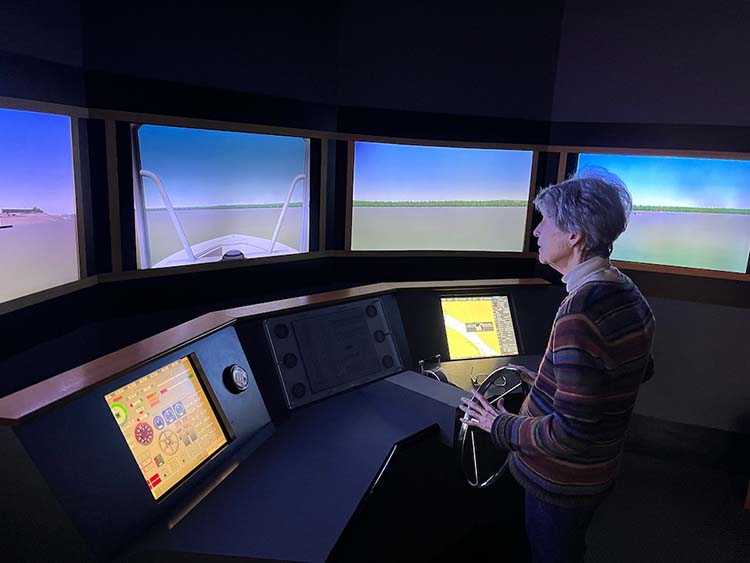
| A pilothouse simulator at the River Discovery Center puts you in charge of a powerboat, a US Coast Guard vessel or a towboat with a string of barges. Image by Tom Adkinson |
PADUCAH, Ky. – Even though Paducah’s National Quilt Museum and its emphasis on art are the city’s biggest contemporary claims to fame, Paducah always will be a river city – and that’s why the River Discovery Center is such an important visitor attraction.
Rivers were the lifeblood of the development of the nation’s interior, and Paducah sits in a strategic location where the Tennessee River flows into the Ohio River. Add the nearby Cumberland and Mississippi rivers to the mix, and that explains why you see references to the Four Rivers Region.
 |
|---|
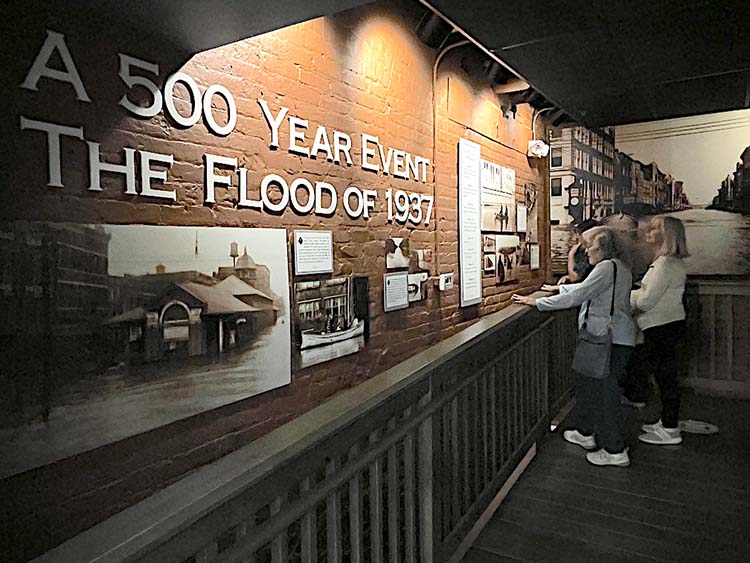
| A sobering explanation of a devastating Ohio River flood in January 1937 is a major exhibition in the River Discovery Center. Image by Tom Adkinson |
The River Discovery Center is on S. Water Street, appropriate since the mighty Ohio River is its neighbor just on the other side of an imposing floodwall that the city decorated with 60 murals depicting scenes from Paducah’s history.
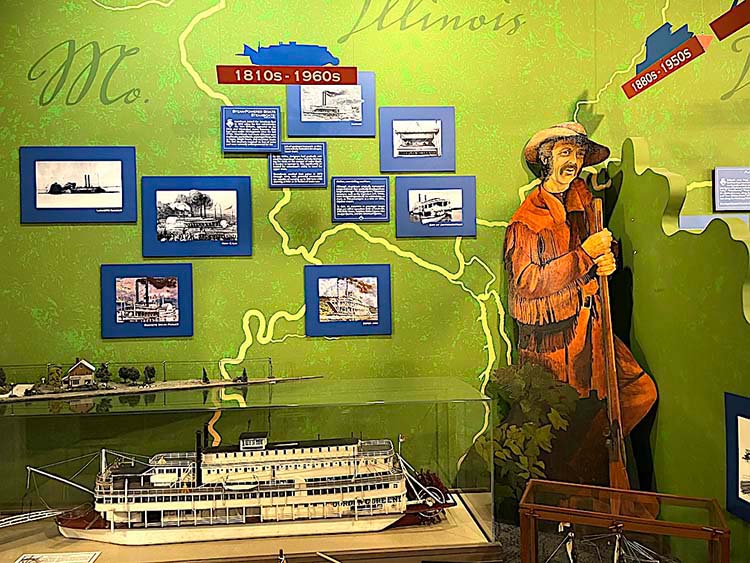
The River Discovery Center tells stories both big and small. Large-scale maps depict the spiderweb of rivers that drain the middle of America, all leading to New Orleans and the Gulf of Mexico, and making clear how those waterways explain the continent’s geography and how vital they were to settlement, commerce, and even warfare. Rivers’ roles in today’s world are another focus, highlighting commerce, recreation, and tourism.
 |
|---|
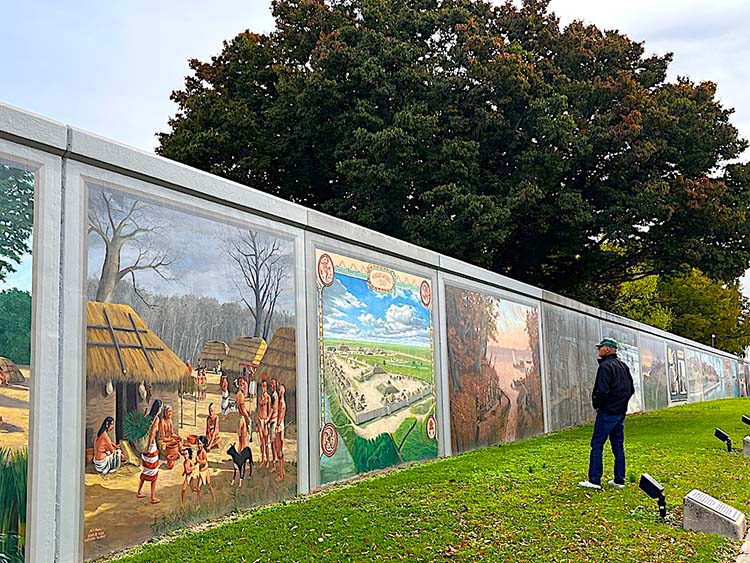
| Paducah turned its floodwall into 60 history-packed murals telling the city’s stories. The Ohio River is on the other side of the wall. Image by Tom Adkinson |
The center’s most interactive exhibit is a navigational simulator that puts you in control of a vessel underway on the Ohio River. You stand in a darkened room where video monitors show the river in front of you. You control speed, direction and, in some cases, how many engines to engage. Choose to pilot a speedboat, a towboat with a string of barges or a US Coast Guard vessel, and then decide whether you want daylight or dark. Don’t necessarily expect smooth sailing. Be prepared when a rainstorm hits or another boat changes your calculation. It is more difficult than you may think to avoid a major highway bridge.
 |
|---|
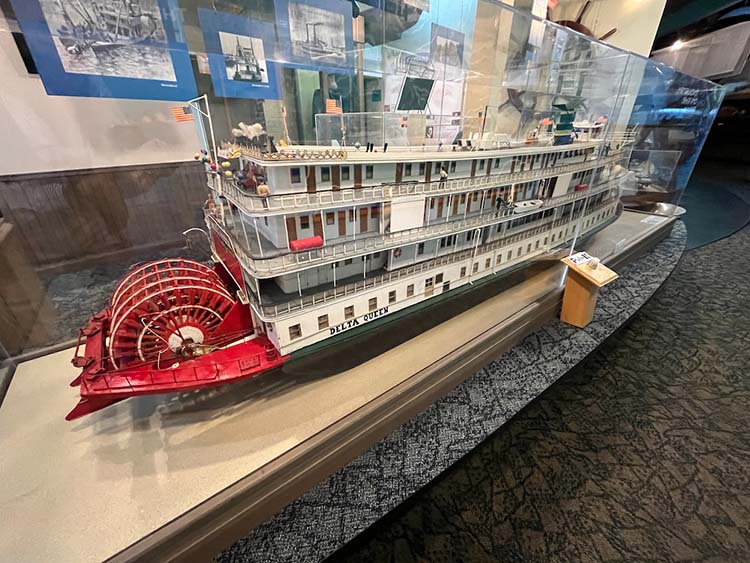
| A cutout of a frontier settler stands before a map dotted with information about riverboat traffic. The model is of the Gordon G. Greene, built in 1923 as a packet boat carrying freight and passengers. Image by Tom Adkinson |
The center’s most illuminating exhibit details the Ohio River flood of January 1937, one of the most devastating floods in American history. Photographs of Paducah’s flooded downtown barely begin to explain the scale of that disaster. Melting snow and massive rainfall amounts upriver – 19.2 inches in Louisville, 14.8 inches in Evansville, Ind., according to the National Weather Service – set the stage. The Ohio River floods at 39 feet in Paducah. The 1937 flood crested at 60.6 feet.
Audio stations featuring folk songs from river history brighten the atmosphere in contrast to the 1937 flood story. Other stations highlight stories of famous riverboat captains, including Capt. Tom Ryman, namesake of Nashville’s famous Ryman Auditorium.
 |
|---|
| The Honeysuckle Hill Farm corn maze honors a Nashville recording artist every year. This year, it’s Lainey Wilson. Image by Tom Adkinson |
A visit to the River Discovery Center brings great focus to the Paducah floodwall. It stretches for blocks across from the center and is an attraction itself. Instead of seeing 13-foot-tall slabs of gray concrete, you see an art project called “Portraits of Paducah’s Past.” Each slab captures a specific moment or aspect of Paducah’s history. One depicts the pre-colonial indigenous people, the Padouca, who gave the city its name. William Clark (of Lewis and Clark expedition fame) chose that name but spelled Padouca as Paducah.
For a final marker of Paducah’s river heritage, stroll away from the river to 210 Broadway. There’s a line of black paint going up the side of the building with a small sign 6 feet 8 inches above the sidewalk – the height of a good-sized University of Kentucky basketball player. That’s the high-water mark from 1937.
Trip-planning resources: RiverDiscoveryCenter.org and Paducah.travel
(Travel writer Tom Adkinson’s book, 100 Things To Do in Nashville Before You Die, is available at Amazon.com.)