Some of Those Ancient Sea Predators Were Built for Surprise Attacks
Submitted by Rutgers University-New Brunswick, Kitta MacPherson, Senior Public Relations Specialist
October 7, 2026, 12:32 p.m.
 |
|---|
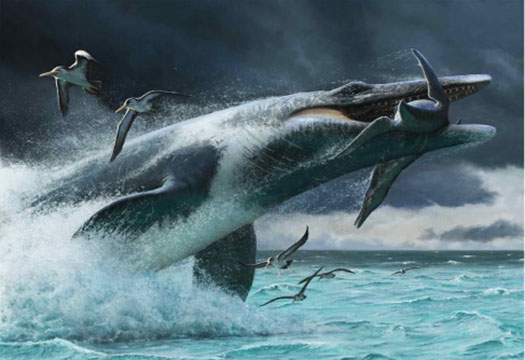
| A mosasaur leaps from the water to snatch prey in this artist’s depiction. A Rutgers-led study suggests differences in the tails of these ancient marine reptiles helped shape their hunting strategies. Credit: Illustration by Henry Sharpe, courtesy of the Formoso Lab/Rutgers University |
Some of the giant marine reptiles that ruled the seas during the age of dinosaurs were better built for surprise attacks, while their relatives were better suited to chasing prey through open water, according to a Rutgers-led study.
These animals, known as mosasaurs, were a group of lizards adapted to life in the ocean. Researchers reconstructed the bodies of four kinds of mosasaurs from their fossil skeletons, then applied principles of physics to estimate how quickly each could surge forward with a single powerful sweep of its tail.
The calculations suggest that a particularly large Tylosaurus, one kind of mosasaur, could have reached about 15 miles per hour with a single tail stroke. That estimate describes a brief burst, rather than the speed the animal could maintain. Although the exact speeds remain uncertain, the differences among the animals offer clues to how they hunted.
 |
|
|---|---|
Rutgers paleontologist Kiersten Formoso studies how animals evolved to live in water. Her new research offers clues to how mosasaurs, marine reptiles that lived during the age of dinosaurs, used powerful tail strokes to launch themselves at prey. Credit: Rutgers University |
The research, published in Current Biology, was led by Kiersten Formoso, an assistant professor in the Department of Ecology, Evolution, and Natural Resources in the Rutgers School of Environmental and Biological Sciences.
“At the same time dinosaurs like T. rex were ruling the land, mosasaurs were ruling the seas,” Formoso said.
Understanding how these predators caught their meals, she said, helps scientists reconstruct how ancient ocean ecosystems worked.
Modern audiences may recognize mosasaurs from the Jurassic World films and the Apple TV series Prehistoric Planet. Formoso consulted on two seasons of the documentary series and early versions of this research helped inform its depictions of mosasaur movement.
Her scientific question began with a difference in the fossils. Two major branches of the mosasaur family tree had differently proportioned tails. Could those differences have affected how quickly the animals launched an attack?
Previous research had largely focused on cruising, a steady type of swimming in which an animal repeatedly beats its tail to move through the water. Formoso wanted to examine the sudden burst that could help a predator seize prey or a smaller animal escape being eaten.
The team modeled a movement it calls a “slam-start.” An animal curls its tail to one side, then forcefully sweeps it back, pushing against the water and driving its body forward.
Formoso compared that initial surge to a swimmer pushing off the wall of a pool.
“It’s the tail itself pushing off the water,” she said.
The nearly complete fossils provided detailed information about body size and tail shape. To reconstruct the missing tail muscles, the researchers drew on the anatomy of living lizards, including Komodo dragons.
The team tested a range of assumptions about muscle power, tail flexibility and resistance from the water to see whether the findings held up under different conditions.
Across the tested conditions, two species, Platecarpus and Tylosaurus, achieved faster lunges for their body size than Mosasaurus and Plotosaurus. Platecarpus was the fastest of the four.
The advantage came largely from a longer, flexible section of the tail that allowed Platecarpus and Tylosaurus to curl it farther before sweeping it back. How far the tail could curl had a much larger effect on the modeled speeds than all other conditions.
Such an advantage would favor ambush hunting in shallowseas, the researchers said. Mosasaurus and especially Plotosaurus appear to have been better suited to pursuing prey in the open ocean.
“That doesn’t mean Plotosaurus was slow,” Formoso said. “Its tail was built for sustained, tuna-like swimming rather than sudden bursts.”
The findings agree with other clues to mosasaur lifestyles, including studies of bite force, tooth wear, and the chemical makeup of fossils.
The study also has a New Jersey connection: Alongside the four main reconstructions, the team modeled exceptionally large animals, including a Mosasaurus based on a fossil from New Jersey held by the New Jersey State Museum in Trenton.
To the authors’ knowledge, this is the first study to put numbers on burst swimming performance in any marine reptile from the age of dinosaurs. They are making their tools freely and publicly available so other researchers can apply the approach to additional extinct swimmers, including animals with no close living equivalent.
Formoso’s broader research examines how animals with land-dwelling ancestors evolved to live in water. Her approach rests on a simple fact: The physical rules that govern swimming today also applied millions of years ago.
“Physics is physics,” she said.
Explore more of the ways Rutgers research is shaping the future.