Submitted By Wildlife Conservation Society
June 9, 2026, 9:21 pm

 |
|---|
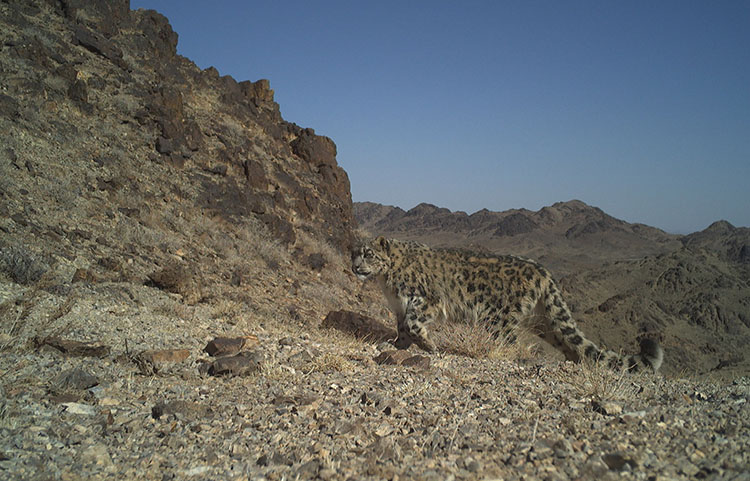
A snow leopard moves across a mountain range between two protected areas in Umnugobi Province. Real-time data from recent GPS collarings efforts will help scientists understand how the cats navigate these highly isolated desert landscapes amid expanding regional infrastructure. Photo credit: ©WCS Mongolia |
ULAANBAATAR, MONGOLIA - In the fragile eastern edge of the global snow leopard range, where disconnected low-elevation mountain habitats intersect with Mongolia’s rapidly expanding infrastructure and changing climate, a team of scientists has placed GPS collars on two adult male snow leopards to help identify and safeguard critical movement corridors across Mongolia’s South Gobi.
The collaring is part of a long-term effort by the Wildlife Conservation Society (WCS), in collaboration with the Government of Mongolia, to better understand and protect snow leopard habitats and movement corridors across the far eastern edge of the species’ global range. Here, isolated mountain systems near the Mongolia–China border are separated by vast desert valleys and increasingly pressured by climate change, mining, roads, railways, and expanding infrastructure.
The collaring took place in remote low-elevation mountain ranges in Umnugobi Province, outside existing protected areas in an extremely dry landscape. Understanding whether this population remains functionally connected to wider snow leopard populations is critical for long-term conservation.
Unlike the higher elevation mountain systems more commonly associated with snow leopards elsewhere in High Asia, this fragile Gobi landscape occurs at relatively low elevations of around 1,800 meters. It supports snow leopards at naturally low densities. Scientists are increasingly concerned that expanding infrastructure and changing climate could further isolate these mountain habitats and restrict movement between remaining snow leopard populations.
The two captured males weighed approximately 42 kg and 39 kg - average weights for healthy adult males - and were safely released back into the mountains following veterinary monitoring and recovery.
The initiative benefited from critical technical support and knowledge exchange with the Snow Leopard Trust and the Snow Leopard Conservation Foundation, organizations that have spearheaded long-term snow leopard research in Mongolia’s Gobi region. Notably, renowned snow leopard researcher Örjan Johansson assisted in training and mentoring the field team in safe snow leopard capture and collaring techniques.
Buuveibaatar Bayarbaatar, Senior Scientist at WCS Mongolia and capture lead for the field effort, said: “This is potentially one of the most vulnerable parts of the snow leopard’s range. These mountain systems are naturally isolated, and now increasing infrastructure and human activity across the Gobi may further restrict how snow leopards move between them. If these connections are lost, populations could become increasingly fragmented and vulnerable over time.”
The collars add to broader efforts by WCS Mongolia and the Mongolian government to conserve ecological connectivity across the South Gobi landscape. The data from the collars will allow scientists to monitor snow leopard movements almost in real time and better understand how the cats navigate landscapes outside protected areas.
Batbayar Galtbalt, Connectivity and Climate Change Manager at WCS Mongolia, said: “This work builds on more than a decade of connectivity research in the South Gobi, including long-term GPS collaring efforts on khulans (Asiatic wild ass) and goitered gazelles across the region. Together, these datasets are helping us understand how wide-ranging wildlife responds to increasing fragmentation and where the remaining functional corridors still exist across the Gobi-steppe ecosystem.”
“Local communities are also increasingly concerned about declining numbers of ibex and argali sheep in some parts of the landscape, which are important prey species for snow leopards. Understanding how snow leopards use these isolated mountains is critical if we are to safeguard both the cats and the wider ecosystem they depend on.”
WCS Mongolia currently works with six community groups across corridor areas in South Gobi, supporting local herders to participate in wildlife monitoring and conservation efforts across unprotected landscapes. Community members from this area participated directly in the collaring effort alongside WCS scientists and veterinarians.
Justine Shanti Alexander, Country Director of WCS Mongolia, said: “South Gobi’s economic landscape is growing at an unprecedented pace. Understanding how snow leopards move through these mountain systems enables data-driven solutions that integrate functional habitat corridors directly into future infrastructure and development plans.”
The collaring effort forms part of WCS Mongolia’s broader strategy focused on maintaining wildlife connectivity and ecosystem resilience in the face of climate change. The South Gobi supports globally important populations of snow leopards, khulans, goitered gazelles, and other nomadic wildlife species that depend on large, interconnected landscapes to survive increasingly frequent extreme weather events such as drought and dzud.
Mongolia supports the world’s second-largest population of snow leopards and plays a globally important role in the conservation of the species. Snow leopards are currently listed as Vulnerable on the IUCN Red List, with habitat fragmentation and climate change among the major long-term threats across much of their range.
Luke Hunter, Executive Director of WCS’s Big Cats Program, said: “Conserving snow leopards today is not only about protecting isolated protected areas. It is increasingly about maintaining the connected landscapes these cats and their prey rely on to move, adapt, and survive in a rapidly changing world. Mongolia remains a stronghold for the species, and this work is critical to understanding and protecting that future."
WCS (Wildlife Conservation Society)
WCS saves wildlife and wild places worldwide through science, conservation action, education, and inspiring people to value nature. To achieve our mission, WCS, based at the Bronx Zoo, harnesses the power of its Global Conservation Program in nearly 60 countries and in all the world’s oceans and its five wildlife parks in New York City, visited by 4 million people annually. WCS combines its expertise in the field, zoos, and aquarium to achieve its conservation mission. Visit: newsroom.wcs.org, Follow: @WCSNewsroom. For more information, call 347-840-1242. Listen to the WCS Wild Audio podcast HERE.