Submitted by The American Newspaper
April 25, 2026, 4:27 pm

 |
The conflict with Tehran has revealed a distinctly personal form of American war-making: vast institutions executing policy, but a
small circle orbiting a president who wants pressure,
control and the final word.
The official machinery of American war is designed to suggest order. The president commands. The Pentagon plans. The State Department negotiates. Intelligence agencies assess. Treasury sanctions. Lawyers justify. Congress oversees. There are chains of command, classified briefings, statutory clocks, interagency meetings and public explanations.
But wars are not run by charts alone. They are shaped by access, instinct, loyalty, ideology, fear and political pressure. They are shaped by who enters the room before a decision is made, who translates a president’s impulses into policy, and who can define victory before events define it for him.
That is the essential fact about America’s Iran strategy in 2026. Formally, it is a national security campaign led by the commander in chief and implemented by the institutions of the federal government. In practice, it has taken the shape of a Trump-centered coercive diplomacy machine, in which military force, sanctions, backchannel diplomacy, legal argument and domestic messaging all orbit around Donald Trump’s sense of leverage.
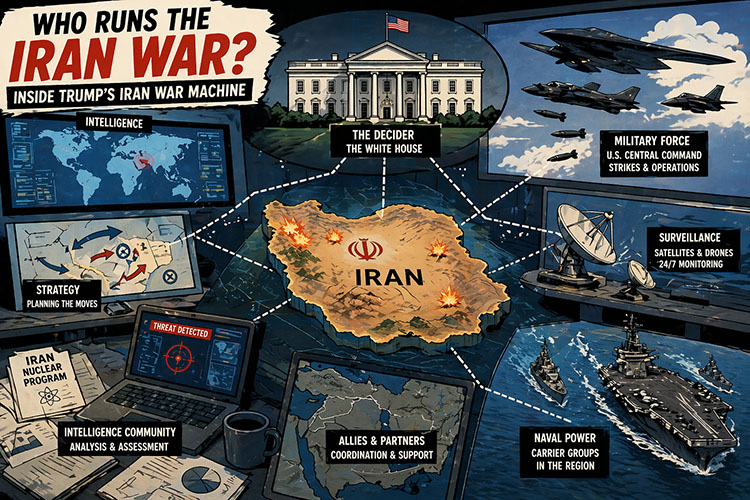
The question in Washington is often reduced to a blunt formulation: Who is in charge? The constitutional answer is simple. Trump is. The more revealing answer lies in the network around him — the officials who interpret his wishes, the commanders who operationalize them, the diplomats who search for an exit, the sanctions architects who squeeze Tehran, the intelligence agencies that map the threat, and the outside actors trying to bend the conflict toward their own preferred end.
A War of Presidential Ownership
Trump’s role in the Iran conflict is not merely legal. It is strategic, political and theatrical.
He sets the ceiling of escalation. He decides whether American force remains limited or expands into repeated strikes, maritime interdiction, deeper attacks on the Islamic Revolutionary Guard Corps, or a broader regional campaign of deterrence. He decides whether a pause is weakness or leverage. He decides whether negotiation is concession or victory.
More important, he defines what the war is supposed to mean. Is it a campaign to prevent Iran from acquiring a nuclear weapon? A punishment for proxy warfare? A defense of Israel and U.S. forces? A coercive effort to force Tehran back to the table? A limited operation to degrade missiles and drones? Or a larger attempt to weaken the Islamic Republic itself?
The public answer is elastic enough to contain several of those aims. That elasticity is politically useful. Hawks hear resolve. Noninterventionists hear limits. Allies hear reassurance. Trump preserves room for a deal. But strategic ambiguity carries its own danger. A war with too many purposes can become a war without a clear stopping point.
Trump’s preferred model appears to be pressure without occupation, punishment without quagmire, escalation without surrendering the option of personal diplomacy. In that sense, Iran is not only a military crisis. It is a test of Trump’s governing style: whether a president who trusts leverage more than process can use American power to force a better bargain without losing control of the conflict he has intensified.
Rubio and the Translation of Power
Inside the administration, Marco Rubio occupies one of the most consequential positions. His importance lies not only in his title as secretary of state, but in his place at the junction of diplomacy, White House coordination and Republican foreign-policy politics.
In a more traditional administration, the secretary of state and the national security adviser often serve as separate centers of influence. One manages diplomacy; the other coordinates policy from inside the White House. When those functions converge around a single figure, policy can move faster, but it can also become more dependent on a narrow circle.
Rubio’s value is translation. He can take Trump’s instincts — strike hard, preserve leverage, keep allies close, leave space for a deal — and convert them into diplomatic language, interagency direction and negotiating posture. He is credible with hawks, fluent in the idiom of pressure, familiar with Congress and able to defend a hard line without foreclosing talks.
He is not the author of the war in the way Trump is. But he may be one of its chief institutional interpreters. His task is to make a personalized strategy legible to allies, agencies and adversaries.
That role matters because Iran policy requires constant synchronization. Military action affects diplomacy. Sanctions affect oil markets. Israeli calculations affect American credibility. Congressional resistance affects legal risk. A ceasefire proposal affects domestic politics. Rubio’s job is not simply to negotiate. It is to hold together the policy architecture around a president who prizes flexibility and distrusts excessive process.
The Pentagon’s Hard Arithmetic
If the White House defines political purpose, the Pentagon bears the burden of making it real.
Defense Secretary Pete Hegseth occupies a role that is both operational and performative. He must project discipline and force. He must reassure Trump that the military is executing his will, reassure hawks that the campaign is serious, reassure skeptics that the United States is not drifting into another open-ended Middle Eastern war, and reassure allies that Washington still controls events in the Gulf.
Beneath him, the uniformed military faces a harder task: preserving military logic inside political urgency. The chairman of the Joint Chiefs must advise on readiness, escalation and risk. CENTCOM must translate presidential direction into target packages, air-defense deployments, naval movements, force-protection measures and contingency plans. The Air Force sustains strike and surveillance capacity. The Navy manages the Strait of Hormuz, where a single miscalculation can reverberate through the global economy.
CENTCOM is where abstraction becomes geography. In Washington, officials speak of deterrence and degradation. In the Gulf, those words become aircraft sorties, drone tracking, convoy protection, mine-warfare risk, missile-defense posture and warnings to Tehran. Theater commanders do not define the political end state. But they determine whether that end state is militarily plausible.
That is the recurring tension in any White House-driven war. Presidents define success in political language. Commanders must test it against distance, logistics, enemy behavior and the unforgiving arithmetic of escalation.
The Strait Where Strategy Meets the Market
Few places expose the fragility of limited war more clearly than the Strait of Hormuz.
For Iran, the strait is leverage. Even when outmatched by the United States, Tehran can threaten costs far beyond its borders through mines, missiles, drones, fast boats, harassment operations and ambiguous attacks on commercial shipping. For Washington, keeping the strait open is both a military mission and an economic necessity.
Here the Iran conflict becomes a global event. A strike on a missile site is one kind of escalation. A disruption in Gulf shipping is another. It affects oil prices, insurance rates, inflation expectations, financial markets and allied politics. The Navy may be the visible instrument, but Treasury, Energy, State and the White House economic team are inevitably drawn into the conflict.
Hormuz is not merely a maritime chokepoint. It is the place where military coercion, energy security and presidential credibility converge.
The Backchannel Presidency
Running alongside the formal structure is another channel typical of Trump’s method: trusted personal diplomacy.
Vice President JD Vance, Steve Witkoff and Jared Kushner represent different forms of access-based influence. Vance matters because he speaks both to the president and to the America First political base. If the war escalates, he can defend it as necessary strength. If it moves toward negotiation, he can help frame the shift as prudence rather than retreat.
Witkoff and Kushner matter for a different reason: trust. In Trump’s world, personal confidence can rival bureaucratic rank. Informal envoys can move quickly, test possibilities and carry messages that official channels may not. In Middle East diplomacy, where personal assurances and leader-to-leader politics often carry unusual weight, that can be useful.
It is also risky. Backchannels can blur authority, bypass institutional expertise and confuse allies or adversaries about who truly speaks for the United States. They can produce speed, but also incoherence.
Still, in Trump’s system, this is not an exception. It is part of the design. Formal diplomacy provides structure. Personal diplomacy provides flexibility. The president prefers both.
Sanctions as the Second Battlefield
The most visible instruments of the Iran war are ships, aircraft and missiles. But one of the most consequential battlefields is financial.
Treasury and the Office of Foreign Assets Control sit near the center of the campaign because the United States can impose pain without occupying territory. It can target oil exports, shipping firms, insurers, banks, refiners, brokers, front companies and dollar-linked financial channels. It can pressure Chinese and third-country buyers. It can threaten secondary sanctions. It can make evasion more expensive.
This is economic warfare by designation, compliance warning, transaction monitoring and fear of exclusion from the U.S. financial system. Its purpose is not only to punish Iran, but to reduce Tehran’s ability to finance missiles, drones, proxies, internal security forces and nuclear infrastructure. It is also meant to create bargaining pressure: sanctions can intensify if Iran resists and ease if Iran accepts terms.
But sanctions are not magic. Iran has spent decades learning how to survive them through shadow fleets, intermediaries, disguised ownership structures and informal finance. Economic war can weaken Tehran and narrow its choices. It cannot, by itself, guarantee submission.
Unless sanctions are tied to a clear political objective, they risk becoming a permanent condition rather than a path to resolution.
The Legal War at Home
Every American war produces a second conflict in Washington: the fight over legality.
The administration’s case rests on familiar grounds — presidential authority, defense of U.S. forces, self-defense, collective defense and the long record of Iranian-backed attacks and threats. Critics answer with an equally familiar objection: sustained hostilities against a sovereign state require congressional authorization.
The War Powers Resolution hangs over the conflict as both law and political clock. Congress can authorize, restrict, fund, defund, investigate or evade responsibility. Historically, lawmakers often prefer ambiguity until a war becomes either popular enough to support or costly enough to oppose.
For Trump, time matters. If he can produce visible success quickly — degraded Iranian capabilities, reopened shipping lanes, a ceasefire, a nuclear concession — congressional resistance may remain contained. If the conflict drags on, legal objections will become harder to dismiss.
The legal debate is not a procedural footnote. It is a struggle over whether a president can transform limited military action into a sustained campaign without a clear legislative mandate.
Intelligence and the Limits of Knowledge
The intelligence community supplies the map of the conflict. It does not drive the car.
The CIA, NSA, DIA, ODNI and military intelligence agencies assess Iran’s nuclear facilities, missile stocks, drone production, cyber capabilities, IRGC networks, proxy forces, regime stability and elite movement. They provide targeting intelligence, retaliation warnings and battle-damage assessments.
Their work is indispensable. But intelligence can estimate, not guarantee. It can warn, not decide. It can tell a president that Iran’s nuclear program has been damaged but not erased, that missile production has been slowed but not ended, that the regime is under stress but not near collapse. The president then decides what level of uncertainty he is willing to accept.
That distinction is especially important in Trump’s Washington. Intelligence shapes the factual environment. Presidential judgment determines the use of risk.
Israel’s Shadow
No outside actor looms larger over the conflict than Israel.
For Prime Minister Benjamin Netanyahu and the Israeli security establishment, Iran is not an abstract adversary. It is the central threat linking nuclear risk, missile warfare, proxy encirclement and regional balance. Israel does not command American policy. But it shapes the atmosphere in which decisions are made. It contributes threat perception, intelligence, diplomatic urgency and political pressure.
Pro-Israel advocacy networks and donors add another layer, influencing congressional incentives and the political cost of dissent. Lawmakers who might hesitate over an open-ended conflict may still find support in a hard line against Tehran.
Trump, however, has a strong reason to maintain visible ownership. His America First brand cannot easily absorb the accusation that the United States has been pulled into war by another country. The distinction between influence and control is therefore essential. Israel is deeply influential. Trump is in command.
A Fracture on the Right
The war has also exposed a division inside American conservatism.
One faction sees Iran as a test of strength. For these conservatives, Tehran is a revolutionary regime, a sponsor of terrorism, an enemy of Israel and a threat to American forces. They support military pressure, sanctions and the willingness to escalate.
Another faction sees the conflict as a betrayal of restraint. For them, Iran may be hostile, but the greater danger is strategic overextension: another Middle Eastern conflict, another open-ended mission, another case in which Washington’s foreign-policy establishment pulls the country away from domestic priorities.
Trump has tried to occupy both sides of this divide. He presents force as deterrence, not nation-building. He frames escalation as a way to end war, not expand it. He keeps open the possibility of negotiation, allowing supporters to imagine a strongman’s deal rather than a neoconservative war.
That balancing act may hold if the campaign is short and produces visible results. It will become harder if U.S. forces suffer casualties, oil prices rise sharply, Iran retaliates through proxies, or the legal fight in Congress intensifies.
The Question of “Enough”
The central struggle is not simply between war and peace. It is among competing theories of what pressure is for.
The limited-war faction wants deterrence. The regime-change faction wants collapse. The negotiation faction wants a deal. The Israel-linked hardline faction wants long-term degradation of Iran’s strategic capacity. The America First noninterventionists want restraint and congressional limits. The sanctions-centered faction wants coercion without large-scale war.
Trump’s current posture borrows from all of them. That flexibility is politically powerful. It is also strategically unstable. Each faction can believe the policy is moving in its direction until events force a choice.
The hardest question in this war is not how to apply pressure. Washington knows how to do that. The harder question is how to define enough: enough destruction, enough deterrence, enough reassurance to Israel, enough protection of U.S. bases, enough sanctions pressure, enough legal authority, enough leverage for a deal.
Without a clear answer, limited war can become rolling war. Coercion can become habit. Pressure can become strategy by inertia.
The Real Command Structure
So whose hands is America’s Iran strategy in?
It is in Trump’s hands first. That is the constitutional and political reality. It is in Rubio’s hands as the translator of presidential instinct into diplomatic and policy form. It is in Hegseth’s, the Joint Chiefs’ and CENTCOM’s hands as the managers of military execution. It is in Treasury’s hands as the designer of economic pressure. It is in the intelligence community’s hands as the supplier of the classified picture. It is in the lawyers’ hands as long as the War Powers fight remains unresolved. It is partly in Congress’s hands, if lawmakers choose to assert themselves.
It is also shaped indirectly by Israel, donors, hawks, conservative media, defense contractors, energy interests, financial markets and noninterventionist critics.
But above all, it reflects Trump himself: personalized, coercive, flexible, suspicious of bureaucracy, comfortable with informal channels and determined to keep the final decision close.
The machinery is vast. The circle is small. The stakes are global. And the oldest question in war remains unanswered: whether the leader who can start the pressure can also decide when it has achieved enough.
[Editorial Note]
This article was produced with AI-assisted drafting and human editorial direction. The final version was reviewed for structure, sourcing, clarity, and analytical coherence by the editor.
[Source/Notes]
This article was written/produced using AI ChatGPT. Written/authored entirely by ChatGPT itself. The editor made no revisions. The model used is GPT-5.5 Thinking. Images were made/produced using ChatGPT.