By West Virginia University
April 20, 2026, 2:20 pm

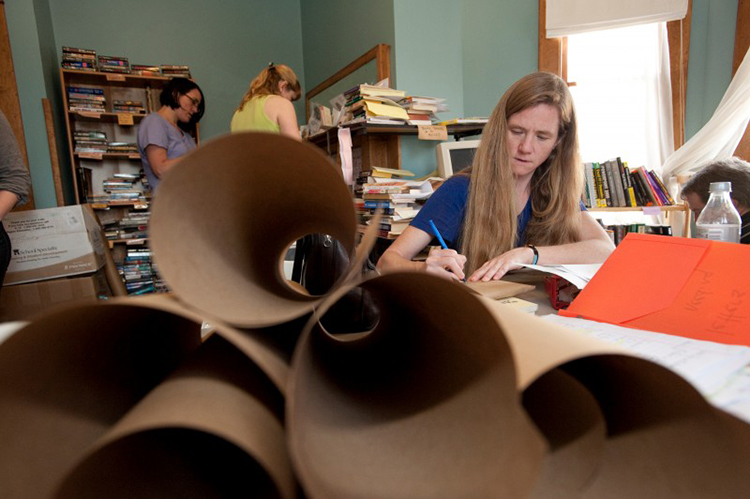 |
Katy Ryan, WVU Eberly Family Professor of Outstanding Teaching and founder of the Appalachian Prison Book Project, has seen prisoners educate themselves, prepare for careers, repair their relationships and change their lives because of access to literature. |
Newswise — With World Book Day approaching on April 23, the founding director of the West Virginia University Center for Prison Education and Research says reading can be a lifeline for incarcerated people.
Katy Ryan, Eberly Family Professor of Outstanding Teaching at the WVU Eberly College of Arts and Sciences, is available to discuss the impact of access to literature on those serving time in correctional facilities.
In her work with the Appalachian Prison Book Project, Ryan has helped ensure that more than 70,000 free books have reached people imprisoned in West Virginia, Virginia, Tennessee, Kentucky, Ohio and Maryland since 2004.
Quotes:
“Books can be a lifeline, a refuge, an inspiration. Reading can transport us to another world and help us understand the one we are in.
“At the Appalachian Prison Book Project, we receive requests for sci-fi, westerns, romance, poetry, manga, for books on math, astronomy, indigenous cultures, LGBTQ+ literature, books by Black writers, books on how to draw or learn music or start a business, books in Spanish, puzzle books.
“We know a book cannot provide everything a person needs, but people who write to APBP have taught us never to underestimate the power of reading. People have told us a book we sent encouraged them to earn a GED, to start writing daily, to reconnect with family, to study science, to learn another language, and so much more. We have an archive nearing 100,000 letters that testify to the importance of having steady access to books.
“In one of our early prison book clubs, we read Natalie Goldberg’s ‘Writing Down the Bones.’ The book inspired one member to write to her adult son and have a difficult conversation. Her son wrote back, they spoke on the phone and, within a few months, he visited her for the first time since she had been incarcerated.
“In 2024, APBP volunteers coedited ‘This Book Is Free and Yours to Keep: Notes from the Appalachian Prison Book Project,’ a collection of letters, artwork, and creative writing from incarcerated people in our region.
“In the preface to that book, Hugh Williams Jr. wrote, ‘I was the one all my teachers gave up on, but ten years later I became a teacher. I taught GED classes, career management and history. It all began with a shivering boy, alone and crying in a cell, wanting to die when he was handed a book of fiction by John Sanford about a detective named Lucas Davenport. I still can’t believe the difference a book can make.’
“Another person told us, ‘I would not be here today if people like yourself had not donated books to prison. I read at a third-grade level when I went in, and because of books that were provided by APBP, I read over a thousand books prior to my release. I escaped prison every day and traveled with Tom Sawyer, Lewis and Clark, Dante, and I traveled with folks in The Canterbury Tales. Little by little I became immersed in literature and began to transform myself into something more than a number.’
“One more testimonial to literature arrived recently from someone newly released. He wrote to us and said, ‘You might say, ‘It's not like we're changing the world,’ but you did change my world.’” — Katy Ryan, founding director, WVU Center for Prison Education and Research