How an Ancient Seafloor Turned Arkansas into a Shark Fossil Hotspot
By Cal Poly Humboldt
Feb 19, 2026
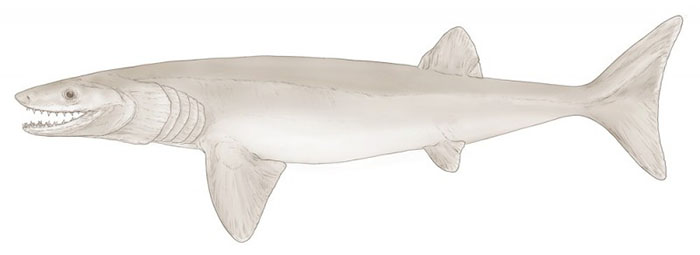 |
|---|
| A reconstruction of a new species of shark, the Cosmoselachus mehlingi, based on a fossil found at the Fayetteville Shale. Illustration by Mick Ellison |
Newswise — Most shark fossils are just teeth—their cartilage skeletons usually decay long before they can fossilize. But in northwestern Arkansas, a series of geological sites known as the Fayetteville Shale has preserved dozens of rare, three-dimensional shark skeletons dating back more than 300 million years. In a new study published in Geobios, researchers reveal why: these fossils formed on a low-oxygen, highly acidic seafloor that preserved cartilage instead of destroying it.
“The fossils provide a glimpse into shark anatomy unparalleled for this period of time anywhere in the world,” says study lead author Allison Bronson, a Biological Sciences professor at Cal Poly Humboldt.
 |
|---|
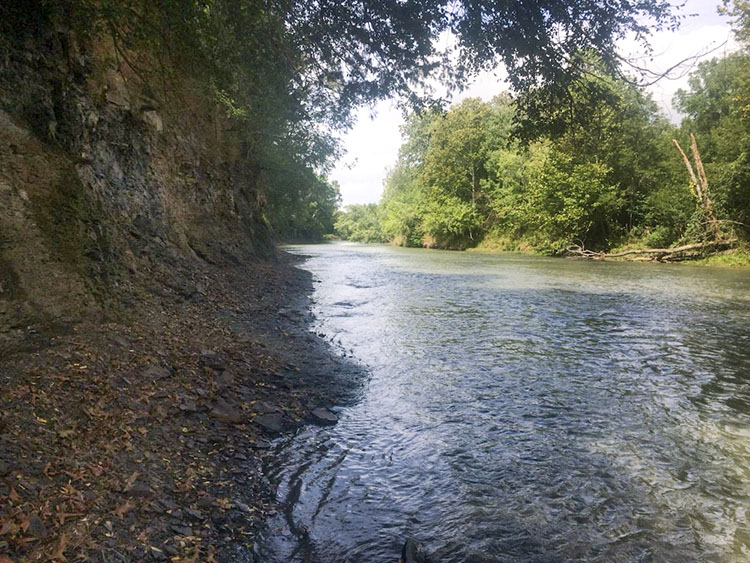
| The White River in Arkansas, where most of these fossils are found. Photo by Alan Pradel |
Cartilage is very rare in the fossil record, says Bronson. Because cartilage rarely fossilizes, the Fayetteville Shale has become a key source of information about the early evolution of sharks and their relatives. By identifying the chemical and sedimentary conditions that made this preservation possible, researchers say the study could also help guide the search for other sites worldwide that may contain similarly rare cartilage fossils.
To learn more about those conditions, Bronson and researchers from the American Museum of Natural History (AMNH), the Museum National d’Histoire Naturelle, the University of Lausanne, and Carleton University reconstructed the conditions that allowed 326-million-year-old shark skeletons to fossilize in such extraordinary detail. The team used X-ray diffraction, X-ray fluorescence, and high-resolution CT scans of the fossils and the rocks that contain them. One of the study’s coauthors, Royal Mapes, donated all of these fossils (and approximately 540,000 more fossils) to the AMNH in 2013 to the AMNH’s Mapes Collection.
Their findings show that the Fayetteville Shale’s unusual chemistry—low oxygen levels and high acidity—slowed bacterial decay, helping to preserve cartilage, while degrading bone and shell. This explains why the formation contains an abundance of shark fossils but very few bony fish, even though bony fish were widespread globally at the time.
 |
|---|
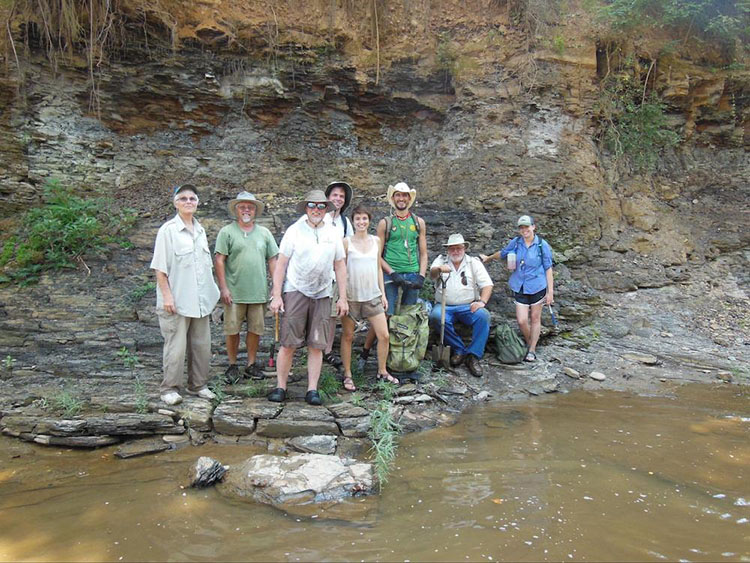
| Field team collecting on the banks of the White River in Arkansas in 2015. From left to right: Gene Mapes, Mark McKinzie, John McCleod, John Denton, Isabelle Kruta, Alan Pradel, Royal Mapes, and Allison Bronson. Photo courtesy of Allison Bronson |
The result, Bronson explains, has produced one of the most important sites in the world for studying shark evolution. “Sharkansas,” as these scientists call it, has some of the best preserved Paleozoic shark skeletons to date, including species that improved understanding of fish evolution, like Ozarcus mapesae, Cosmoselachus mehlingi, and Carcharopsis wortheni.
Crucially, this environment preserved fossils in three-dimensional condition, allowing researchers to visualize structures like the cranium, inner ear, and brain cavity, which are often flattened, if preserved at all, in most other conditions.
The team plans to revisit “Sharkansas,” but, in the meantime, they are working through the AMNH collections. “Each time I visit the museum’s Fossil Fish collection,” says Bronson, “I discover something new.”