By Michael Williams
Mar 29, 2026
 |
|---|
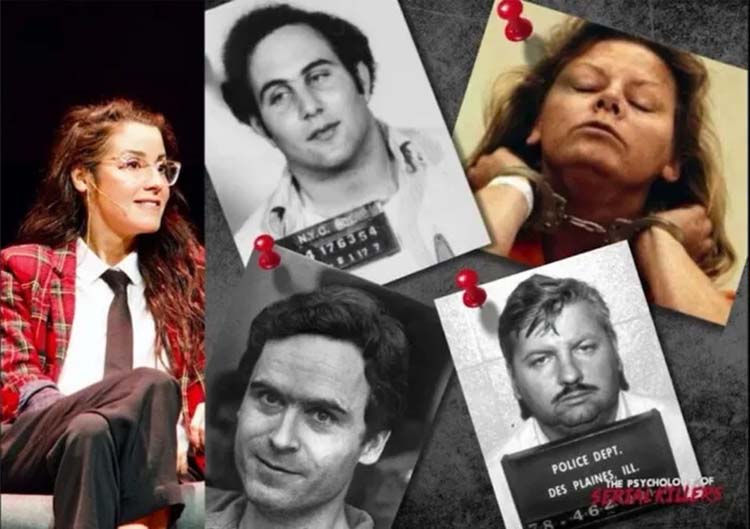
| Dr Rachel Toles is pictured with (Clockwise from top) David Berkowitz, Eileen Wournos, John Wayne Gacy and Ted Bundy. Toles is a Forensic Psychologist that will be presenting a talk at Bijou Theater about the psychology or serial killers and why they captivate us. |
When Rachel Toles was 5 years old, she witnessed a tragic murder that left a lasting impression on her. One that would alter her destiny and send her exploring a dark, sinister, sadistic world inside the minds of serial killers.
“I was five and standing on a street corner with my mother,” Toles recalled. “I saw someone push a young girl into traffic into an oncoming car, and she was killed.” This traumatic event had a lasting and immediate impact on the young Toles.
“I started drawing pictures of wars, decapitations, and other grisly scenes,” Toles said. “My teachers became quite concerned.”
Fortunately, Toles directed her traumatic experience into something productive, unlike many of the notorious serial killers she has chronicled. Toles is now a Dr. of forensic psychology, true crime consultant, and criminal expert specializing in the psychology of serial killers, mass shooters, and violent behavior.
Dr. Toles will be presenting “The Psychology of Serial Killers and why they captivate us” at the Bijou Theater on Monday, May 18, at 7:30. The event is a two-hour lecture with Q&A in which Toles discusses her research and what she has learned about these elusive, deadly human predators that stalk silently and undetected, seeking their victims.
Why are serial killers intriguing to most people? According to Toles, it is primarily because of the rarity of these individuals and the twisted motives and methods of their deeds.
“It’s because they are the albino squirrels of the murder world,” Toles said. “97% of murders are unplanned. Most are committed in the heat of the moment. Serial killers get addicted to murder. It’s so rare that many people are fascinated by them.”
Toles relates startling statistical facts, such as 65% of serial killers are here in the United States. While the U.S. comprises only 4% of the world population, it is also the breeding ground of more serial killers than any other nation. Toles suggested that it is the lack of mental health programs in this nation that would allow these troubled individuals to seek counseling to control their murderous impulses. “England has programs for mental health, and they have only 3% of the known serial killers,” Toles said.
In her research toles has interviewed several notorious serial killers, including William Suff, also known as the “Riverside County Killer,” who was convicted of killing 12 women; Randall Woodfield, dubbed the I-95 Killer, who was linked to 18 murders and Keith Jesperson, AKA The Happy Face Killer who was convicted of eight slaying but confessed to as many as 160.
“There are nine factors that produce serial killers,” according to Toles. Often its generational trauma and begins in the womb.” Toles said generational trauma begins when a child is still in the womb, as when an expectant mother smokes, drinks, and uses drugs, such toxic chemicals have a lasting effect on the unborn child. In the case of a drug user, children are often born as addicts with their tiny bodies racked with pain from withdrawal. Thus begins the first of the many traumas that many serial killers endure during their troubled childhoods.
Other factors that produce serial killers include absentee fathers, violence in the home between the parents, brain injury, being bullied in school, sexual abuse, and shaken baby syndrome. Most serial killers have experienced several, if not all, of these factors.
“At the ages of 8-12, children who have grown up in these type environments develop a fantasy of being in control,” Toles said. “Sometimes this desire to be in control leads to violent impulses. A person’s brain isn’t fully developed until they are 26. Until then, they don’t fully comprehend the consequences of their actions.”
Toles cites the case of Dylan Klebold, who, with his accomplice, Eric Harris, killed 13 students and one teacher in the Columbine shootings in 1999. Klebold’s parents were largely too preoccupied to pay much attention to their son. Though he had photos of Adolf Hitler on his walls and a copy of “Mein Kampf,” his parents dismissed this as a phase.
“Parental neglect was a factor in this case,” Toles said. “Dylan and Eric saw themselves as anti-heroes. They had planned Columbine the day before by setting off explosives in the school cafeteria. They hoped to kill 500. But the materials they needed didn’t arrive in time. April 19 was the anniversary of the Oklahoma City Bombing. So they carried out the shooting on April 20.”
Coincidentally, April 20 was Hitler’s birthday.
Toles said female serial killers are rare, and on most occasions, they have male accomplices. Aileen Wuornos was a rare exception. Her accomplice was her girlfriend.
“It’s all about compartmentalizing,” Toles said. “When females are traumatized, they naturally internalize trauma. They develop feelings of inferiority. Boys externalize trauma. They lash out.”
The difference between a serial killer and a mass murderer is the difference in their thought processes. Tim McVeigh was a mass murderer who fancied himself a revolutionary and saw himself at war with the U.S. government. According to Toles, the thought processes of serial killers such as Ted Bundy are different.
“For a serial killer, it’s an adrenaline rush. Once they kill, they take ownership of the body. And it’s the thrill of the hunt. They will play with the body occasionally committing necrophilia,” Toles said. “But they are in control. Typically, after they kill 2-3 victims, they stop for a while and enter a cooling-off period. Mass killers don’t do this. Once the adrenaline rush wears off, they kill again. At that point, they reason ‘Well, I’m going to hell anyway. What difference does it make if I kill again?”
Once serial killers are in prison, they tend to settle down, with some becoming model prisoners, as in the case of the notorious Son of Sam Killer, David Berkowitz. Toles explained, “Once they are in prison, they tend to settle down. They are in a more structured environment, and they see the guards and the warden as authority figures. By the time they go to prison the are getting older and are tired.”
Serial killers have always been present in society. As is the case with H.H. Holmes, who terrorized Chicago from 1891-94 killing a confirmed nine people in his Murder Castle, although authorities estimate they may have been as many as 27 victims. And during World War II, the Nazi death camps were a serial killers’ domain as they had free rein to terrorize, harm, and murder countless victims. Among the most inhumane was Irma Grese, who made lamp shades from the tattooed skins of murdered Jews. After the war, she became the youngest convicted war criminal to be hanged for her crimes against humanity. She was 22 when she went to the gallows.
Fortunately, according to Toles, the peak of the serial killers ended in 1987. Due to heightened surveillance and improved methods of detection and DNA, fewer people are willing to risk life sentences for carrying out their deadly fantasies of committing the perfect murder. Nonetheless, as Toles points out, F.B.I. statistics state there may be as many as 500 serial killers in the U.S. as of now.
Dr. Rachel Toles is an accredited Clinical and Forensic Psychologist who has worked as a technical consultant for Dick Wolf Productions, ABC Nightline, HBO Max, Investigation Discovery, NBC Universal, and others.
As a speaker, she presents nationally and internationally on the psychology of homicide, pathways to violence, and the warning behaviors that often appear years before an act becomes public.