For Winter Interest Consider Native or European Hornbeam
UT Gardens’ January Plant of the Month
Submitted by James Newburn, managing director, UT Gardens, Knoxville
Jan 5, 2026

#CommissionsEarned

#CommissionsEarned

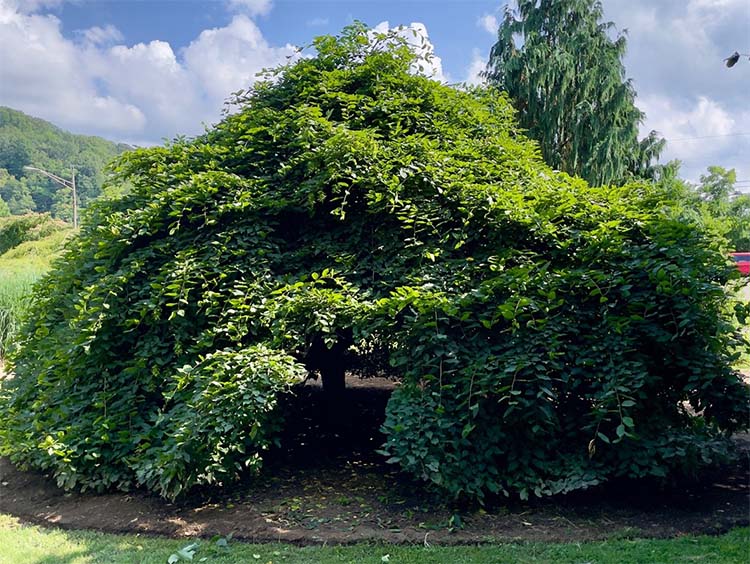 |
| Weeping hornbeam is a secret hide-away in summer. Photo courtesy UTIA |
Enjoy upright, columnar or weeping forms during all four seasons
Gardening for winter appeal is often not considered when choosing ornamental trees for the landscape. By choosing “four-season trees” you enjoy the look of your garden year round.
Think of it as landscape efficiency. Why plant one tree for each season when you could choose a “four-season tree” with year-round interest. After shedding their leaves in the fall, several deciduous tree species reveal beautiful branching patterns that provide sculptural elegance and sophistication to the garden.
Carpinus, or hornbeam, a member of the birch family, has such appeal, though a bit more subtle than other species in its transition from one season to another. There are typically only two species available commercially–C. betulas European hornbeam and C. caroliniana American hornbeam.
Hornbeams have very hard dense wood, usually with a fluted trunk and smooth bark, giving the trunks a flexed muscle texture and thus one of its common names, musclewood. Both species are relatively small understory trees, typically reaching 20 to 40 feet tall, and they are equally happy growing in full sun as well as in the shade (or dappled shade) of taller trees.
In spring as the bright green leaves emerge, catkins filled with flowers begin forming and dangle gently from the branches like Christmas ornaments on a tree. There are separate male and female catkins on the same tree with the female flowers producing a small nut. As summer approaches, the green leaves darken and grow 2 to 5.5 inches long and are food sources for several lepidoptera species.
Our native hornbeam, C. caroliniana, typically displays an upright spreading form with an often irregular rounded to flat top. The European, C. betulas, is more oval and a bit more civil, if you will. Both species have columnar, fastigiate (upright) and even weeping forms available. Newer introductions include narrow varieties with very dense upright branching that can form a living screen. Hornbeams respond well to pruning, allowing them to be maintained as an impenetrable hedge.
Leaves are typically golden in fall although there are American hornbeam introductions with red autumn color that include Ball O’ Fire, Firespire, and Palisade. What makes this a “four-season tree,” though, is apparent after it defoliates for winter. The imagination is sparked by the sinuous branching, the tightness of a hedge, or the revelation of the graceful structure of the umbrella.
Hornbeams can be found in all three UT Gardens campuses.
The UT Gardens includes plant collections located in Knoxville, Crossville and Jackson, Tennessee. Designated as the official botanical garden for the State of Tennessee, the UT Gardens are part of the UT Institute of Agriculture. The Gardens’ mission is to foster appreciation, education and stewardship of plants through garden displays, educational programs and research trials. The Gardens are open during all seasons and free to the public. For more information, see the Gardens website: utgardens.tennessee.edu.
The University of Tennessee Institute of Agriculture is comprised of the Herbert College of Agriculture, UT College of Veterinary Medicine, UT AgResearch and UT Extension. Through its land-grant mission of teaching, research and outreach, the Institute touches lives and provides Real. Life. Solutions. to Tennesseans and beyond. utia.tennessee.edu.