
May 27, 2026

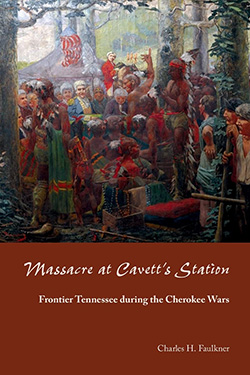
In the late 1700s, as white settlers spilled across the Appalachian Mountains, claiming Cherokee and Creek lands for their own, tensions between Native Americans and pioneers reached a boiling point. Land disputes stemming from the 1791 Treaty of Holston went unresolved, and Knoxville settlers attacked a Cherokee negotiating party led by Chief Hanging Maw resulting in the wounding of the chief and his wife and the death of several Indians. In retaliation, on September 25, 1793, nearly one thousand Cherokee and Creek warriors descended undetected on Knoxville to destroy this frontier town.

#Commissions earned
 |
 |
|---|---|
A landmark new exhibition — with free admission for 250 days — explores the first treaty between the Constitutional United States and the Cherokee Nation, and how that history has been remembered, misremembered, and contested ever since.
Less than 2,000 feet from the front door of the East Tennessee History Center, one of the defining events in American history took place during the summer of 1791. On July 2, Territorial Governor William Blount and a number of Cherokee chiefs gathered at the mouth of First Creek and signed the Treaty of Holston — the first formal agreement between the newly Constitutional United States and the Cherokee Nation.
That document drew lines on a map. It also drew lines in law and in memory, many of which have never been erased.
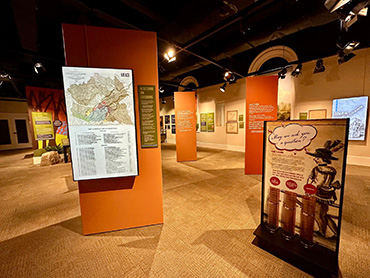
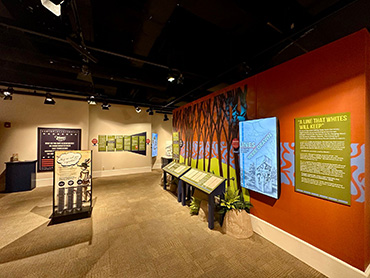
Beginning June 1, 2026, and running through February 14, 2027, the East Tennessee Historical Society invites you to visit Lines Were Drawn |ᏚᏂᏍᏓᏅᏅᏁᎯ (Du Ni Sda Nv Nv Ne Hi): The Treaty of Holston and Its Legacy, a landmark exhibition that places visitors at the center of Tennessee’s early history on the 250th Anniversary of the United States.
Free museum admission, beginning on June 1, 2026, for 250 days in commemoration of the 250th Anniversary of the United States is made possible through the generosity of Marvin House.
 |
 |
|---|---|
“Lines Were Drawn tells a story that is central to our nation’s founding and reveals the importance and complexities of frontier politics in the region that would become East Tennessee,” says Dr. Warren Dockter, President/CEO of the East Tennessee Historical Society.
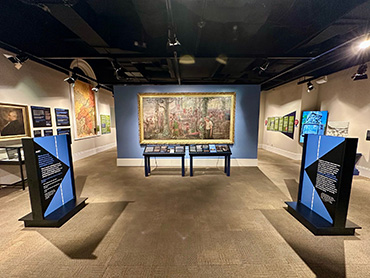
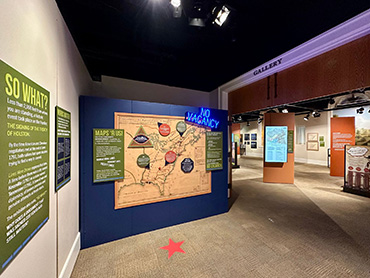
Lines Were Drawn traces the events that led to the Treaty of Holston from the fall of Fort Loudoun and the British Royal Proclamation of 1763, through the American Revolutionary War, the formation of the Southwest Territory, and on to the decades of Cherokee resilience, removal, and survival that followed. The exhibition draws on historic maps loaned by the Calvin M. McClung Historical Collection, Knox County Public Library, primary source documents from the National Archives, and artwork from the McClung Museum of Natural History and Culture and the Tennessee State Museum.
The exhibition also features animated map sequences, engaging video presentations, and five interactive visitor-response stations that invite each visitor to locate themselves within the history.
Importantly, the exhibition does not stop at the treaty itself. Its second major theme is historical memory: how the signing of the Treaty of Holston was recorded, retold, and at times embellished. Visitors move through an arc of secondary sources from John Haywood's early histories, which became intellectual scaffolding for Indian Removal, to J.G.M. Ramsey's 1853 Annals of Tennessee, to James W. Wallace's 1901 painting The Signing of the Holston Treaty, to Raymond Kaskey's 1998 limestone sculpture at Volunteer Landing. At each turn, visitors are confronted with the same question: how does each retelling of the historic event shape our understanding of the past today?
“Historical memory is not a filing cabinet of organized facts,” the exhibition text observes. “It is a crowded attic filled with dusty stories, traditions, and objects — some missing.”
Lines Were Drawn was funded under an agreement with the State of Tennessee, administered by the Tennessee Commission for the United States Semiquincentennial.
For more information on East Tennessee History Museum, please visit easttnhistory.org or call 865-215-8899.