By Tom Adkinson
June 12, 2026
 |
|---|
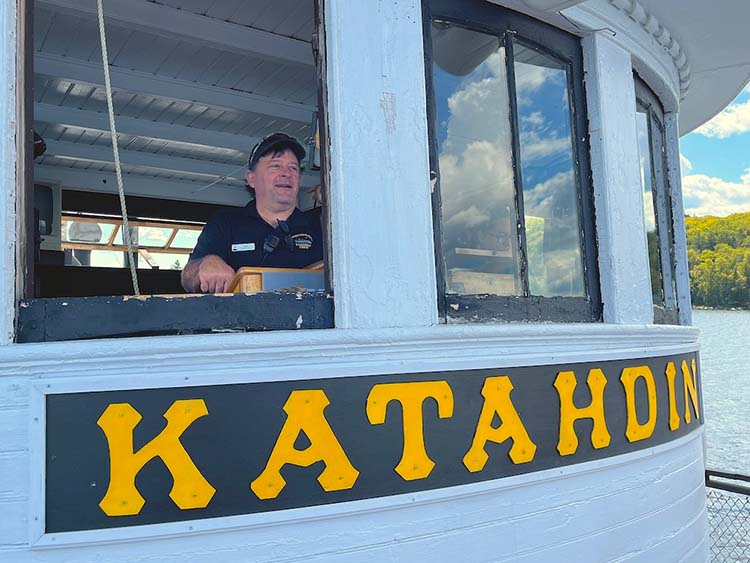
| Captain Matt Kane, one of three on the Katahdin’s staff, offers a mild smile after parallel parking the 102-foot-long excursion boat. Image by Tom Adkinson |
GREENVILLE, Maine – More than 4 million people troop through the coastal wonders of Maine’s Acadia National Park every year, but there’s a substantially less-visited area approximately three hours’ drive inland that holds a special treat – an excursion on a historic boat well into its second century of operation.
The area is the Maine Highlands, and the vessel is the Katahdin, commonly called the Kate, which operates out of tiny Greenville (population roughly 1,400). A date with Kate is an outing on Moosehead Lake that travels back in time and through an especially rural part of a rural state. There just aren’t many people up here in northern Maine.
 |
|---|
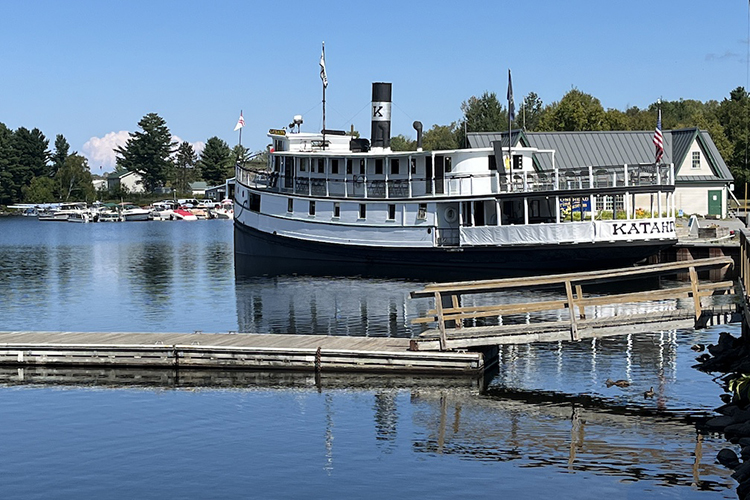
| The Katahdin, which has been plying the waters of Moosehead Lake since 1914, rests at its dock in Greenville between excursions. Image by Tom Adkinson |
The Katahdin’s playground is substantial. Moosehead Lake covers 74,890 acres, making it Maine’s largest lake and the largest lake east of the Mississippi River entirely within one state. It is approximately 40 miles long and up to 10 miles wide, and 80 islands dot its surface.
Moosehead Lake is the only body of water the Katahdin has known, and it was no small feat getting the vessel here. The steel hull was built on the coast at Bath Iron Works, shipped inland in pieces by train, hauled some more by oxen, and ultimately assembled in Greenville. That was in 1914. The Katahdin once had the companionship of more than 40 other commercial boats. Today, she is the only one left, which is one reason she is on the National Register of Historic Places.
 |
|---|
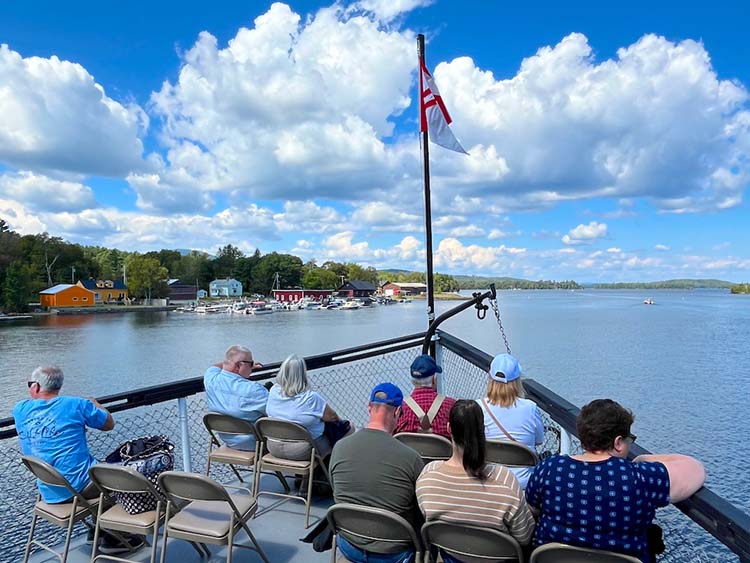
| Passengers scurry to the bow of the Katahdin to get their favorite views of Maine’s largest lake. Image by Tom Adkinson |
Propulsion switched from coal to diesel in 1922, and the Katahdin carried people, supplies and mail until the late 1930s. Part of the narration on a trip today tells of the fancy summer resort scene that thrived along the lake until the Great Depression tamped down that segment of the region’s economy. A predecessor of Scott Paper then bought the Katahdin, and she became a workhorse in the timber business.
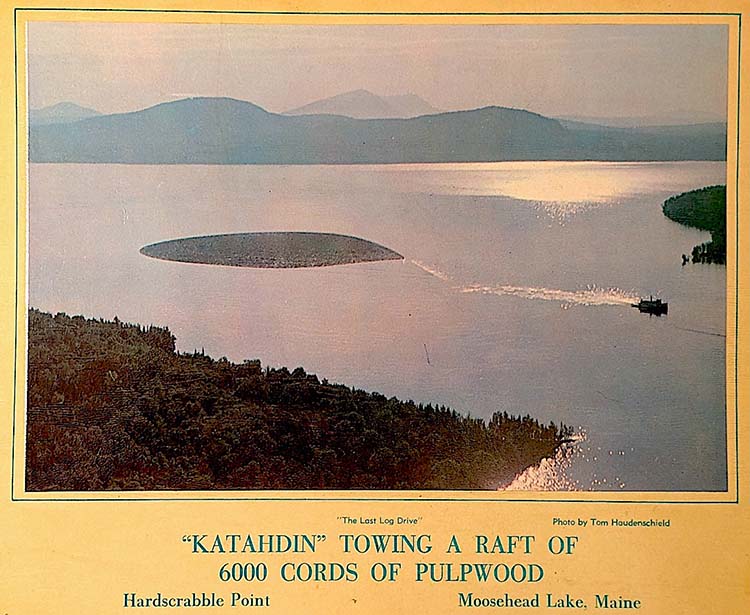
Instead of carrying felled trees, the Katahdin towed them. Loggers constructed veritable islands of logs roughly 750 feet wide and 1,750 feet long, the equivalent of 30 acres, which the Katahdin towed across the lake to the headwaters of the Kennebec River. Loggers dismantled the islands and floated the logs to mills in the town of Kennebec to make paper, plywood, and other wood products.
 |
|---|
| This historic photograph shows the Katahdin towing a 30-acre log raft on the last trip of its kind on Moosehead Lake in 1976. Image courtesy of Moosehead Marine Museum |
The Katahdin was part of what was called the Last Log Drive in 1976, and her owners let her fall into disrepair before transferring ownership to Greenville locals who eventually had the vision of forming a nonprofit and bringing her back to life. The Moosehead Marine Museum, which doubles as the ticket office, acquired the Katahdin in 1977.
The Katahdin’s most popular trip is a 3-hour midday outing called the Sugar Island Cruise. Mt. Katahdin, famous for being the northern terminus of the Maine-to-Georgia Appalachian Trail, is visible about 45 miles away on clear days, in part because it is Maine’s highest peak (5,269 feet).
 |
|---|
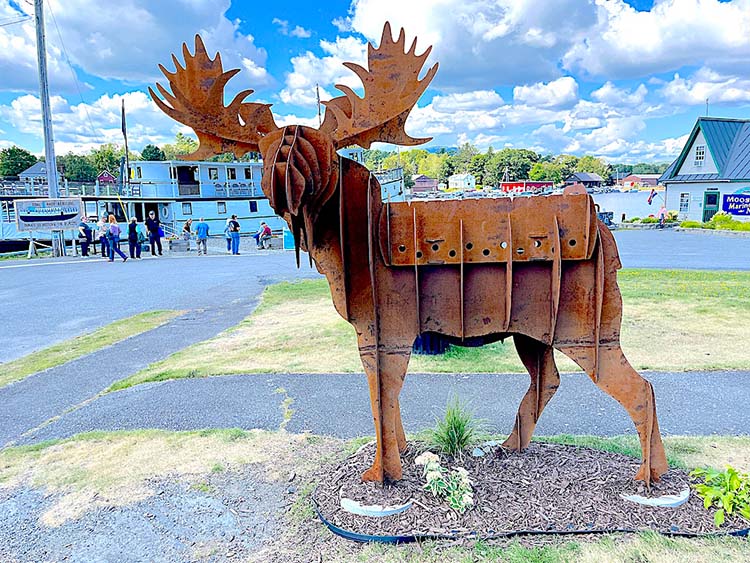
| Passengers aren’t guaranteed to see a moose on the shore during an excursion, but this sculpture is at the dock. Image by Tom Adkinson |
Maine’s green scenery (except in autumn when the deciduous trees flash their brilliant colors) is constantly appealing. Birders watch for bald eagles, great blue herons, ospreys, and peregrine falcons.
 |
|---|
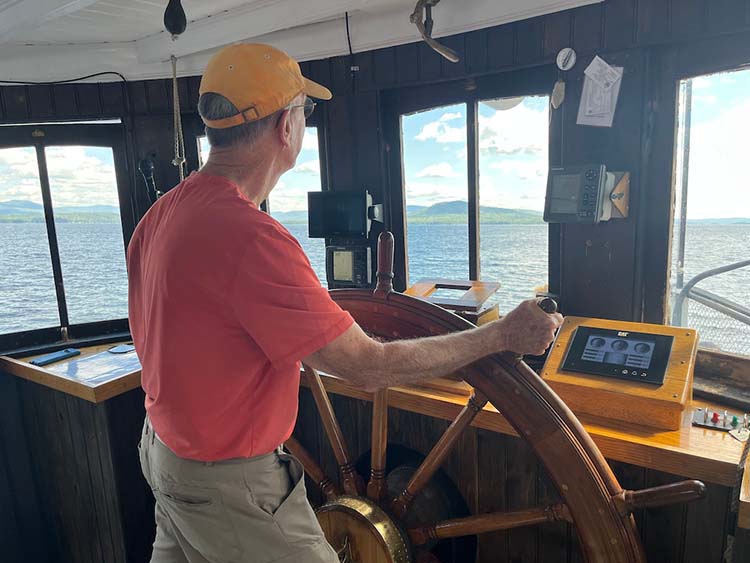
| In certain circumstances, the captain of the Katahdin will allow an interested passenger a chance to steer this historic boat. Image by Tim O’Brien |
Approximately 9,000 people a year enjoy dates on the Kate between June and October, when winter is imminent. As big as Moosehead Lake is, it freezes to an average thickness of three feet. At that point, the Kate season is long past, and the lake becomes a venue for snowmobiling, ice fishing, and automobile racing on a quarter-mile oval marked on the ice about two miles from Kate’s dock.
Trip-planning resources: KatahdinCruises.com and VisitMaine.com
(Travel writer Tom Adkinson’s book, 100 Things To Do in Nashville Before You Die, is available at Amazon.com.